Description
Govern what your AI agents can do, not only what they say
AI agents now query databases, issue refunds, change code, open tickets, send messages and call other agents. Most governance programs were built for models and outputs, so they cannot answer the questions that matter once software acts on its own: which systems can this agent change, under whose authority, and how fast can we stop it?
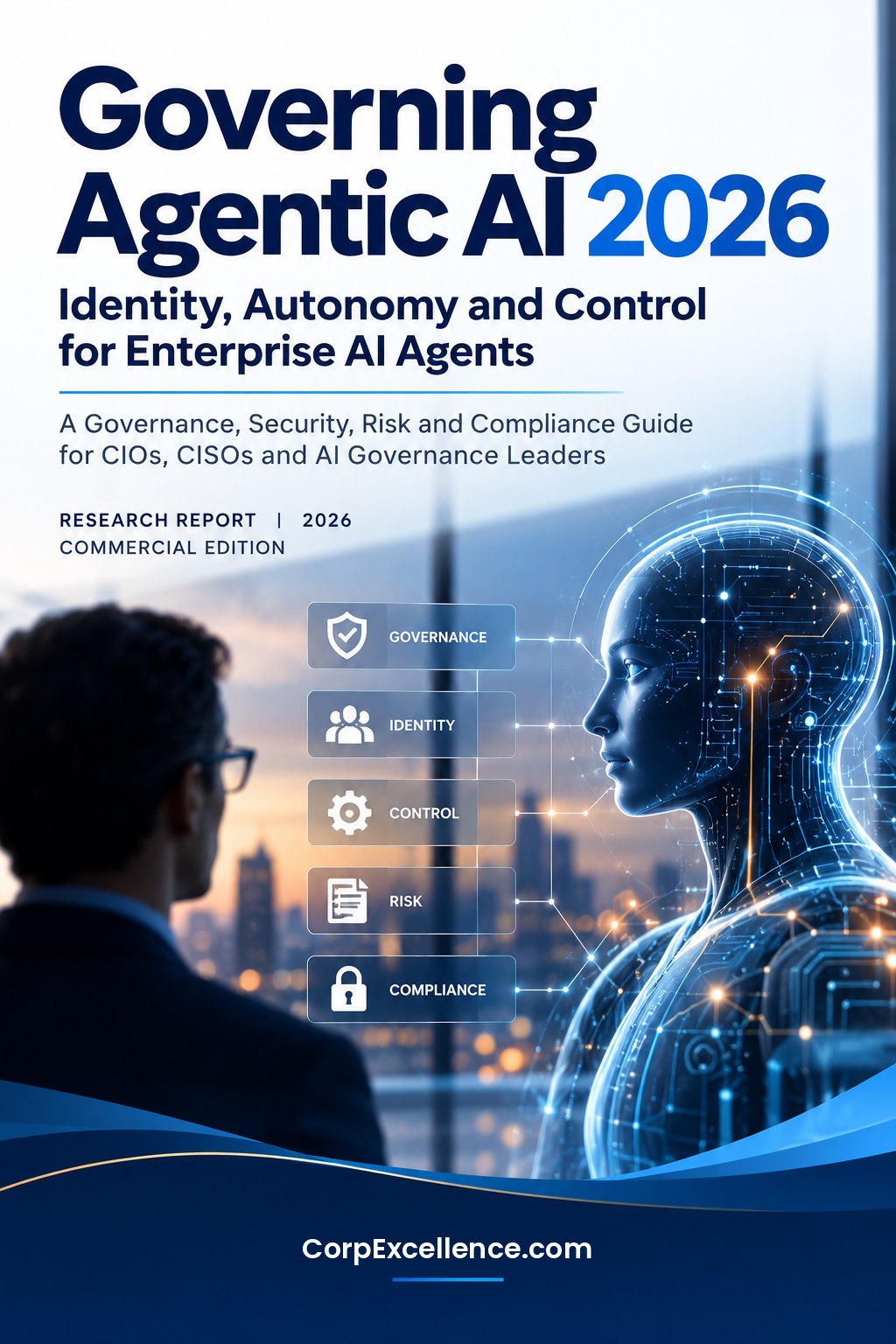
Governing Agentic AI 2026 gives CIOs, CISOs, AI governance leaders and risk teams a practical method for governing enterprise AI agents. Its position is simple: governance attaches to the actions an agent can take and the authority behind them, with evidence that the agent stays inside approved bounds. Autonomy is set for each class of action, control effort scales with risk, and the heaviest controls go to the few agents that can move money, change production systems, contact outside parties or shape decisions about people.
What the report covers
Original frameworks
- The Agent Autonomy Scale (A0 to A5): Inform, Query, Prepare, Supervised Action, Bounded Action and Delegating Orchestrator, with minimum controls for each level and rules for moving an agent up or down.
- The Six-Plane Agent Control Model: Mandate, Identity, Connectivity, Context and Memory, Oversight, and Assurance, all resting on an accountability spine of registry entry, named owners, risk tier and recorded risk acceptance.
- Agent risk tiering (Tier 1 to Tier 4) that scores impact, reach and autonomy, with mandatory overrides for high-consequence agents and worked examples.
Building and running agents safely
- Agent inventory and registry: how to find the agents already in use, including those embedded in software you license, and assign business and technical owners.
- Agent identity and authorization: one identity per agent, recorded delegation when an agent acts for a person, short-lived scoped credentials, and common identity anti-patterns to replace.
- Governing connectivity: tools, Model Context Protocol (MCP) servers, Agent2Agent (A2A) peers and agent gateways, with intake review, allowlisting, version pinning and egress control.
- Context, data and memory governance: indirect prompt injection through documents and email, provenance tagging, memory poisoning, retention and privacy.
- Human oversight that holds up: why per-action approval prompts degrade, and approval designs that route by risk and give reviewers the information they need.
- Runtime guardrails: enforcement outside the model, task and spend budgets, step limits, circuit breakers and kill switches that are tested.
- Testing, evaluation and red teaming by tier, release gates, and how to handle agents that game their evaluations.
- Observability, audit trails and incident response: the minimum audit record for an agent action, incident severity levels, containment and forensics.
- Multi-agent systems and delegation: trust between agents, cascading failures and design rules for orchestrators.
Threats, vendors and regulation
- The agentic threat landscape, with the OWASP Top 10 for Agentic Applications mapped to the six control planes and a table of selected agent security incidents from 2025 and 2026.
- Third-party, embedded and vendor agents: shared responsibility, vendor defaults, contract clauses, liability and financial services expectations.
- The regulatory picture for AI agents across the EU AI Act, US federal and state developments including Colorado, California and Texas, sector regulators such as FINRA and the UK FCA, and international frameworks from Singapore, Australia and Canada. Presented as general insight to confirm with counsel, not legal advice.
- A control crosswalk mapping the six planes to ISO/IEC 42001, the NIST AI RMF, the OWASP agentic list, MITRE ATLAS and other references, so each control is written and evidenced once.
Operating model and rollout
- Accountability and executive reporting: an agent governance council, first and second line roles, the agent owner role, approval authorities by tier, a RACI and an executive agent risk scorecard.
- Five scenario playbooks: a customer service agent that issues refunds, a coding agent with repository and CI access, a finance operations agent handling invoices and supplier changes, an IT operations agent remediating production incidents, and a research agent browsing the web.
- Implementation roadmap: a 90-day plan and a 12-month roadmap.
Ready-to-use tools included
The appendices are templates you can adopt inside an existing AI governance, security or risk program.
- Appendix A: Agent registry template
- Appendix B: Agent risk-tiering worksheet with scoring levels and sign-off
- Appendix C: Pre-deployment readiness checklist, organized by control plane
- Appendix D: Tool and MCP server intake review
- Appendix E: Agent permission request template
- Appendix F: Human oversight design checklist
- Appendix G: Agent incident response runbook
- Appendix H: 40-question vendor agent due-diligence questionnaire
- Appendix I: Model agent governance policy
- Appendix J: Glossary of agent governance terms
- Appendix K: One-page executive checklist
The report also contains 47 tables and 6 figures, including the minimum controls by plane and tier, the runtime limits every production agent should have, and a worked action-class autonomy matrix.
Who this report is for
- CIOs and CTOs approving agents for production use
- CISOs, security architects and identity teams responsible for non-human identities and agent access
- AI governance leads and risk, compliance and internal audit teams building agent controls
- Procurement, legal and third-party risk teams buying or renewing products with embedded agents
- Product and engineering leaders deploying agents built on MCP, A2A or vendor agent platforms
- Executives and board members who need a clear view of agent risk
Report details
- Format: PDF, 67 pages, US Letter
- Edition: Version 1.0, Commercial Edition, 2026
- Sources: 141 numbered references to standards bodies, regulators, government agencies, research and public provider documentation, current as of October 2026
- Delivery: instant download after purchase
- License: the purchaser may use the worksheets, checklists, templates and model policy internally. Redistribution or resale requires written permission from CorpExcellence.com.
This report is independent, best-effort research. It is not legal, regulatory, compliance or other professional advice. Laws, standards, protocols and products change quickly, so confirm current requirements with the official sources and qualified advisers before relying on them.