Research · Data for AI
Privacy & Data Sovereignty in AI
AI systems often process personal data, and AI services often process it across borders. Privacy law and data sovereignty requirements shape what data you can use, where it can go and what you must tell people.
The AI Data Boundary Check
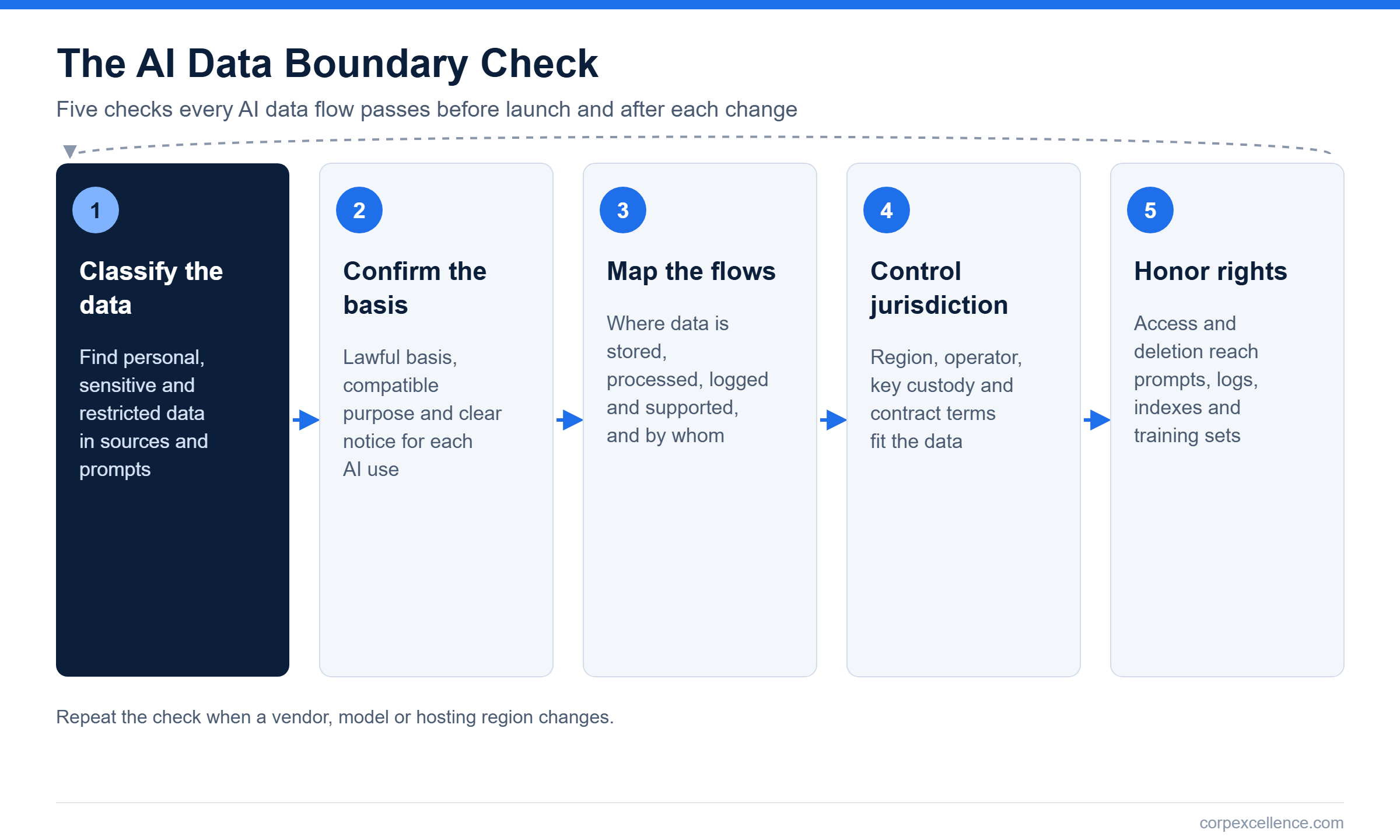
Privacy and sovereignty questions about AI tend to surface late, when a pilot is ready to scale and someone finally asks where the prompts go. The AI Data Boundary Check is a CorpExcellence framework of five checks that every AI data flow should pass before launch, and again whenever a vendor, model or hosting region changes. It applies equally to models you build and to AI services or agents you buy.
Classify the data and confirm the basis
Start by finding personal data, special category data and restricted business data in training sets, retrieval sources, prompts and outputs. Then confirm the lawful basis and purpose for each use. Data collected to serve customers does not automatically extend to training a model on their records. In the EU, the EDPB’s Opinion 28/2024 explains how controllers should test legitimate interest for AI development and when a model can be treated as anonymous. Notices should tell people plainly when AI processes their data.
Map the flows and control jurisdiction
Data location is only one part of sovereignty. A useful map records four facts for each flow:
- Residency: where data, prompts, logs and backups are stored and processed.
- Operations: who runs and supports the service, and from which countries.
- Legal exposure: which governments could compel the provider to disclose data.
- Key custody: whether you or the provider controls the encryption keys.
Match the controls to the data class. Public content may run on any approved global service, while regulated or citizen data may need a regional deployment, customer-held keys or a sovereign offering with local operations.
Honor rights everywhere data lands
Access, correction, deletion and objection requests must reach every place AI copies data, including fine-tuning sets, vector indexes, conversation logs and caches. Design these paths before launch. Removing a person from a trained model is far harder than removing a row from a database, so where possible keep personal data in retrieval sources, where it can be deleted, rather than in model weights.

Residency is only one of six sovereignty dimensions
AI Infrastructure Sourcing 2026 breaks sovereignty into data, operational, legal, cryptographic, control-plane and continuity dimensions, and shows how to verify each one with evidence.
Where the industry is now
As of September 2026, the GDPR amendments in the EU Digital Omnibus, including a proposed provision on legitimate interest for AI training, are still under negotiation, so current GDPR rules and EDPB guidance continue to apply. The EU Data Act has applied since September 12, 2025, adding rules on switching between cloud providers that buyers can use when negotiating AI and data platform contracts. Sovereign options have expanded: the AWS European Sovereign Cloud became generally available in January 2026, and the European Commission has made its Cloud Sovereignty Framework, built to score providers in its own procurement, available to other organizations.
Common pitfalls
- Assuming a regional endpoint means prompts, logs and support access also stay in that region.
- Accepting vendor terms that allow customer data to be used for model training.
- Leaving conversation logs out of retention and deletion schedules.
Research report
Turn sovereignty requirements into infrastructure decisions
Get the 47-page report to sovereign cloud, hyperscalers, neoclouds and private AI, with placement hard gates, an evidence request list and a contract red-flag checklist.
Featured research report

AI Infrastructure Sourcing 2026
47-page report to hyperscalers, neoclouds, sovereign cloud and private AI compute. Includes a 50-question provider due-diligence questionnaire and decision worksheets.
Questions leaders should ask
- Where do our AI services process and store our data?
- Have we told customers and employees how AI uses their data?
- Can we honor deletion requests for data used in AI?
- Which personal data may never be sent to external AI services?
More in Data for AI
Related research reports
In-depth reports with ready-to-use templates.
- AI Infrastructure Sourcing 2026$49.99 PDF report
- AI-Ready Data$59.99 PDF report
Latest Analysis: Privacy & Data Sovereignty in AI
Explore articles addressing this research topic as new analysis is published. The newest articles appear here automatically.
Related research reports
Reports connected to this topic.