Research · AI Governance, Risk & Compliance
AI Audit & Assurance
AI audit and assurance provide independent evidence that AI systems and the controls around them work as intended. Demand is rising from boards, regulators, customers and, in some cases, laws that require audits.
The AI Audit-Readiness Ladder
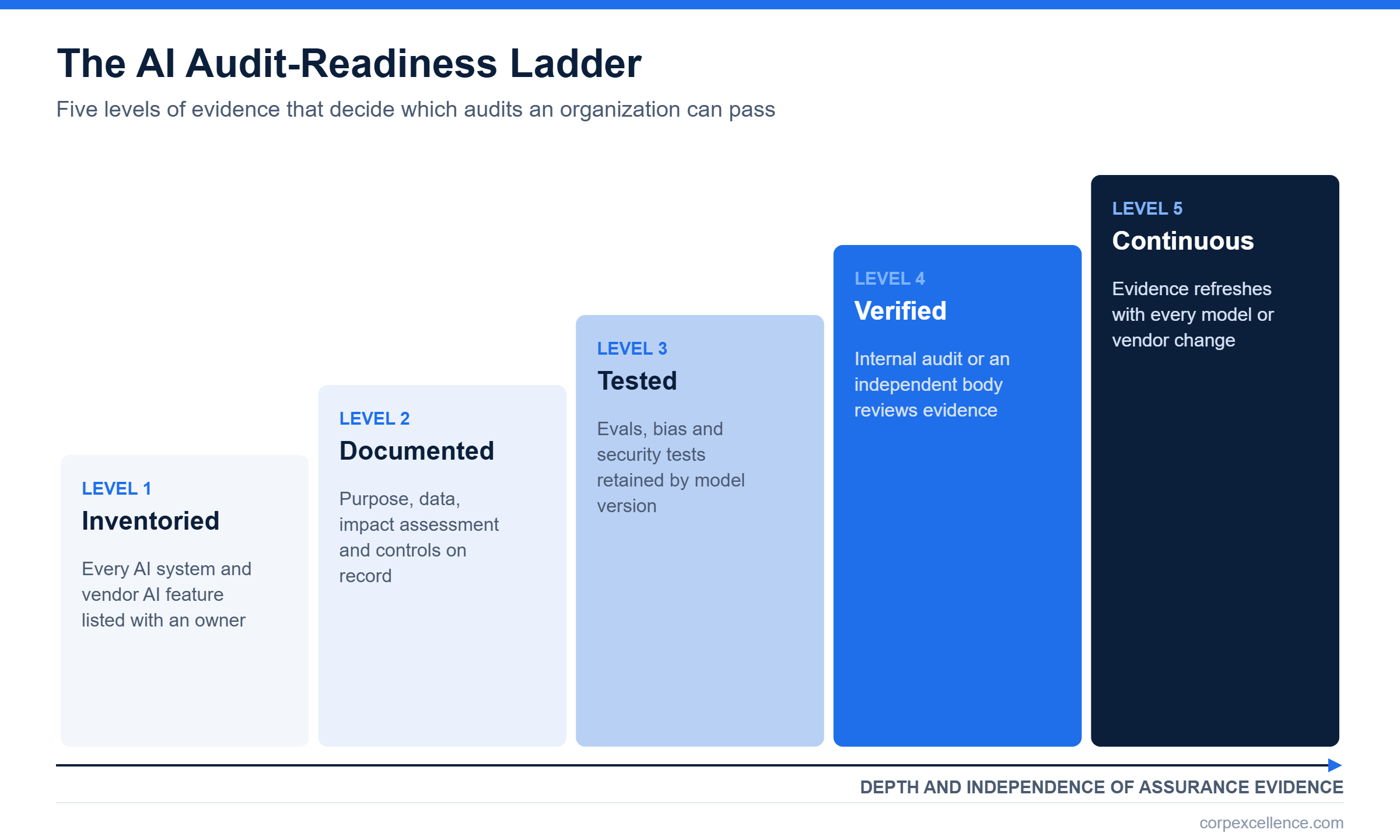
An audit can only confirm what an organization can show. The AI Audit-Readiness Ladder, a CorpExcellence framework, describes five levels of evidence maturity, from knowing which AI systems exist to producing assurance that stays current as models change. Each step makes a more demanding form of audit possible, whether that is an internal review or an accredited ISO/IEC 42001 certification.
Levels one and two: inventoried and documented
Auditors start with scope. The first request is usually an inventory that lists every AI system, including AI features inside vendor products and agents, with a named owner and a risk tier. Documentation follows: intended purpose, data sources, impact assessment, applicable controls and the approvals given. Tie the inventory to procurement and change management so new AI is captured when it arrives. Without these, an audit turns into a discovery exercise and the findings are easy to predict.
Level three: tested
Policies show intent; test results show performance. Retain evaluation results for accuracy, fairness, security (including prompt injection for generative and agentic systems) and drift, each with a date and the model version tested. Evidence that cannot be tied to a specific version will not satisfy an auditor once the model has been updated.
Level four: verified
Verification means someone independent of the build team reviews the evidence. Options range from internal audit to accredited certification bodies. ISO/IEC 42006, published in July 2025, sets requirements for bodies that audit and certify ISO/IEC 42001 management systems, including auditor competence and audit time, which gives buyers a basis for judging the quality of a certificate. Some laws require independent audits: New York City’s Local Law 144 requires bias audits of automated employment decision tools.
Level five: continuous
AI systems change faster than annual audit cycles. At the top of the ladder, monitoring and evaluation pipelines produce evidence automatically, and every model or vendor change triggers a control review before release. Certification then rests on live evidence rather than a pre-audit scramble, and surveillance audits between recertifications become routine checks of evidence that already exists.
Where the industry is now
As of September 2026, AI assurance is becoming a profession with its own credentials. ISACA launched its Advanced in AI Audit (AAIA) certification in May 2025 for experienced, credentialed auditors. The UK government’s trusted third-party AI assurance roadmap (September 2025) set out plans for a skills framework and an assurance innovation fund. Enforcement remains uneven: a December 2025 New York State Comptroller audit found gaps in New York City’s enforcement of Local Law 144. Under the EU AI Act, after the AI Omnibus, high-risk obligations including conformity assessment apply from December 2, 2027 for Annex III systems and August 2, 2028 for AI embedded in regulated products.
Common pitfalls
- Auditing principles instead of evidence.
- Relying on vendor certificates without checking their scope.
- Assembling documentation in the weeks before the audit.
- Keeping test results that cannot be traced to a model version.
Research report
Audit what your AI agents actually did
Governing Agentic AI 2026 defines the minimum audit record for an agent action, release gates and an incident runbook, so evidence comes from independent logs rather than the agent’s own account.
Featured research report
Governing Agentic AI 2026
67-page playbook for governing enterprise AI agents: autonomy levels, risk tiers, agent identity, MCP controls and human oversight. Includes 10 ready-to-use templates.
Questions leaders should ask
- When did internal audit last review our AI governance?
- What evidence could we produce today for our highest-risk AI system?
- Do any laws require us to audit specific AI uses?
- Do our auditors have the skills to assess AI?
More in AI Governance, Risk & Compliance
Related research reports
In-depth reports with ready-to-use templates.
- Governing Agentic AI 2026$59.99 PDF report
- Third-Party AI Risk$59.99 PDF report
Latest Analysis: AI Audit & Assurance
Explore articles addressing this research topic as new analysis is published. The newest articles appear here automatically.
Related research reports
Reports connected to this topic.