Research · AI Governance, Risk & Compliance
Third-Party & Vendor AI Risk
Much of the AI in any organization comes from vendors: features inside SaaS products, AI services and outsourced processes. Third-party AI risk management extends vendor oversight to cover how suppliers build, use and change AI.
The Vendor AI Exposure Matrix
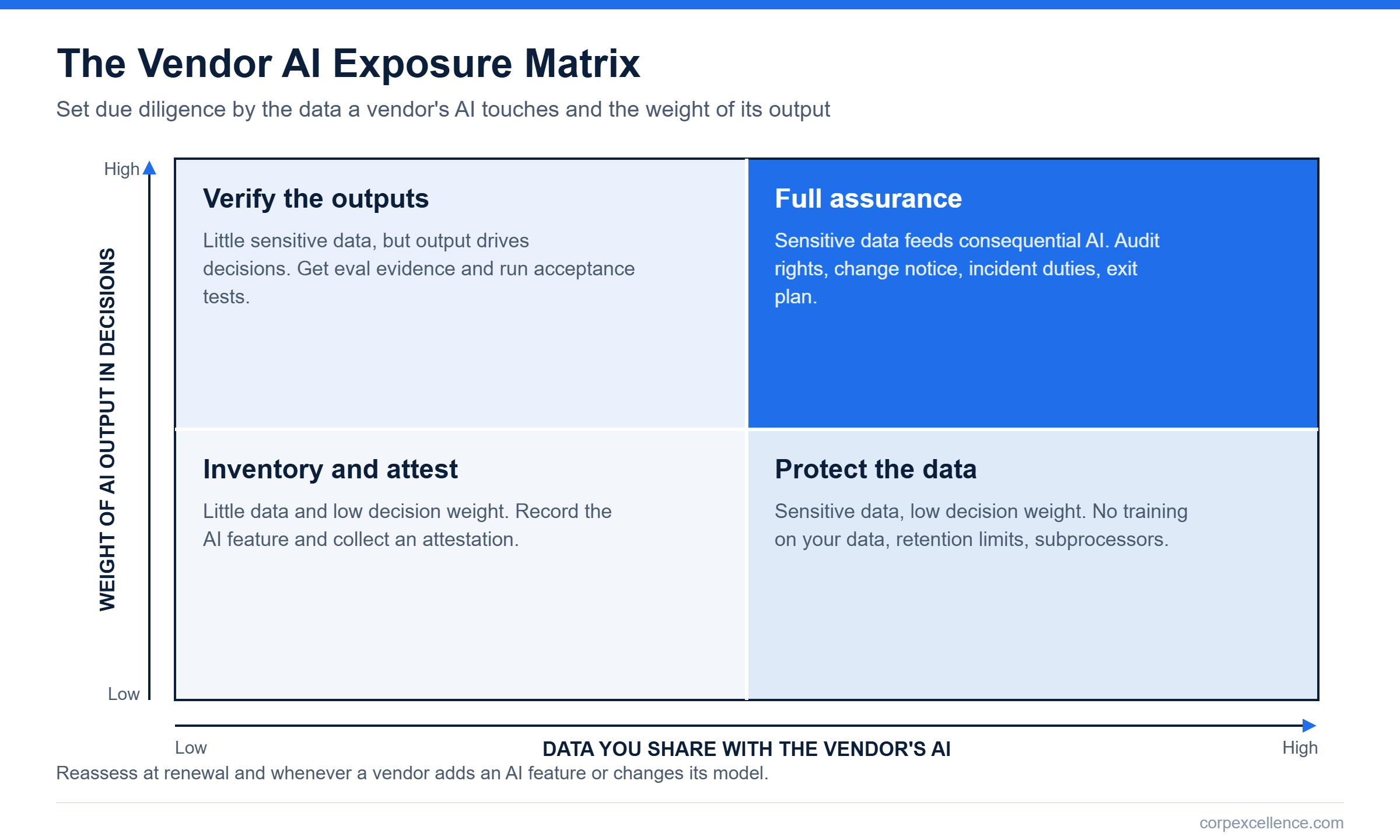
Most enterprise AI arrives through suppliers: copilots inside SaaS tools, model APIs, agents that connect to internal systems, and outsourced services that adopt AI without much announcement. The Vendor AI Exposure Matrix, a CorpExcellence framework, sorts each vendor relationship on two questions. How much of your data does the vendor’s AI touch? How much weight do its outputs carry in decisions about customers or money? The answers set the depth of due diligence and the contract terms you need.
Reading the four quadrants
- Inventory and attest (little data, low decision weight): record the AI feature and who owns it, then collect a vendor attestation.
- Protect the data (sensitive data, low decision weight): prohibit training on your inputs and outputs, set retention limits, list subprocessors (including the model provider behind the vendor) and confirm where data is processed.
- Verify the outputs (little data, high decision weight): ask for evaluation results and known limitations, and run your own acceptance tests before relying on the outputs.
- Full assurance (sensitive data, high decision weight): complete assessment, audit or testing rights, advance notice of model changes, incident reporting duties and a tested exit plan.
Contract terms that matter now
Standard SaaS terms rarely cover AI. Add clauses on training rights, notice before new AI features or model changes, AI incident notification, cooperation with your regulatory obligations, and data and model portability at exit. US federal agencies already contract this way: OMB memo M-25-22 (April 2025) requires contracts to prohibit vendors from using non-public agency data to train commercial models and asks agencies to consider requiring notice before new AI features are added. For buyers in Europe, the Commission’s updated model contractual clauses for AI procurement (March 2025) offer starting text.
Keep the matrix current
Positions move. A vendor that switches on an agent feature or swaps its underlying model can jump from the bottom left to the top right in a single release. Reassess at renewal and whenever the vendor announces an AI change, and watch for AI features enabled by default. Agents that reach your systems through connectors or the Model Context Protocol deserve particular attention: the OWASP Top 10 for Agentic Applications, released in December 2025, names tool misuse and identity and privilege abuse among the leading agent risks.
Assessing an AI supplier? Grade the evidence, not the claims
Third-Party AI Risk tiers AI suppliers on four exposure factors and grades every claim on the Assurance Evidence Ladder, from V0 Claim to V4 Contracted.
Where the industry is now
As of September 2026, obligations are moving down the supply chain. Since August 2, 2025, providers of general-purpose AI models under the EU AI Act must give downstream providers documentation of capabilities and limitations. ISO/IEC 42001 includes Annex A controls for third-party and customer relationships, so a certified vendor should be able to show how it manages its own suppliers. Ask for that evidence rather than accepting a certificate logo.
Common pitfalls
- Reviewing vendors once at onboarding and missing AI added later.
- Treating an ISO/IEC 42001 certificate as proof that a specific feature is safe.
- Forgetting the fourth party: the model provider behind your vendor.
- Leaving AI out of the vendor inventory because the purchase was classed as ordinary SaaS.
Research report
Run AI vendor risk as a lifecycle, not a questionnaire
Get the AI supplier intake form, tiering worksheet, due diligence questionnaire, evidence request list, contract clause checklist and monitoring scorecard.
New research report
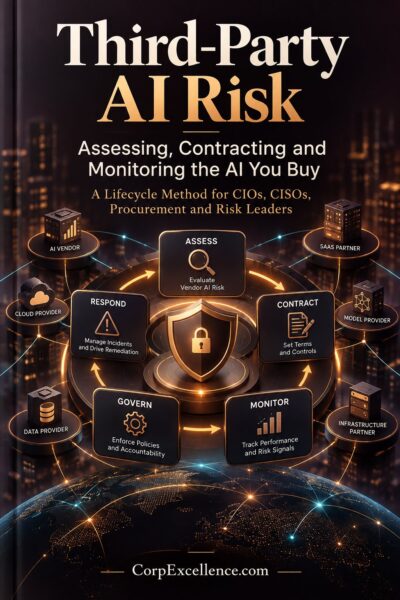
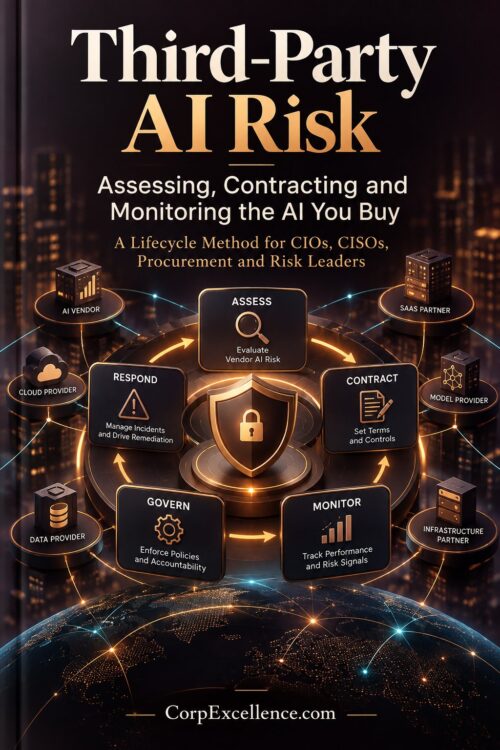
Third-Party AI Risk
60-page lifecycle method for assessing, contracting and monitoring the AI you buy. Includes intake, tiering, diligence and contract templates.
Questions leaders should ask
- Which of our vendors use AI on our data today?
- Do our contracts prevent vendors from training models on our data?
- How would we learn that a vendor changed its AI model?
- Which vendor AI features are enabled by default?
More in AI Governance, Risk & Compliance
Related research reports
In-depth reports with ready-to-use templates.
- Third-Party AI Risk$59.99 PDF report
- Governing Agentic AI 2026$59.99 PDF report
Latest Analysis: Third-Party & Vendor AI Risk
Explore articles addressing this research topic as new analysis is published. The newest articles appear here automatically.
Related research reports
Reports connected to this topic.