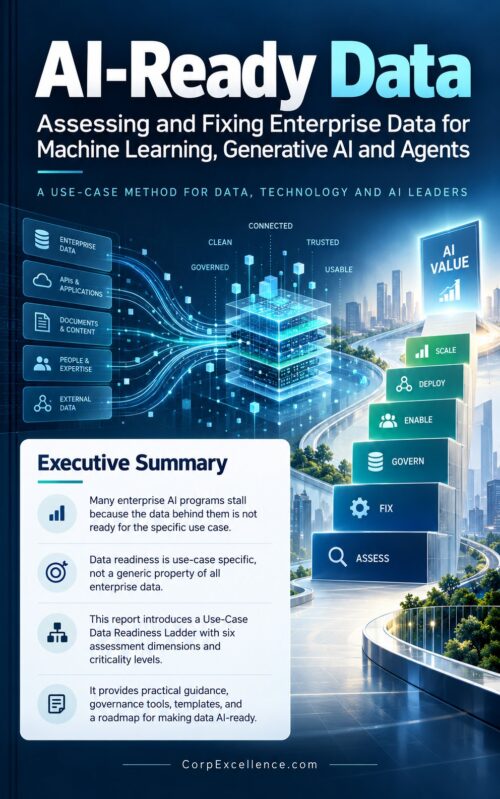
Research · Data for AI
Data Quality & AI Readiness
AI readiness is not a general property of your data. It depends on the use case. Data that is fine for monthly reporting may be too incomplete, inconsistent or poorly labeled for an AI system that makes decisions or answers questions.
The Use-Case Data Readiness Ladder
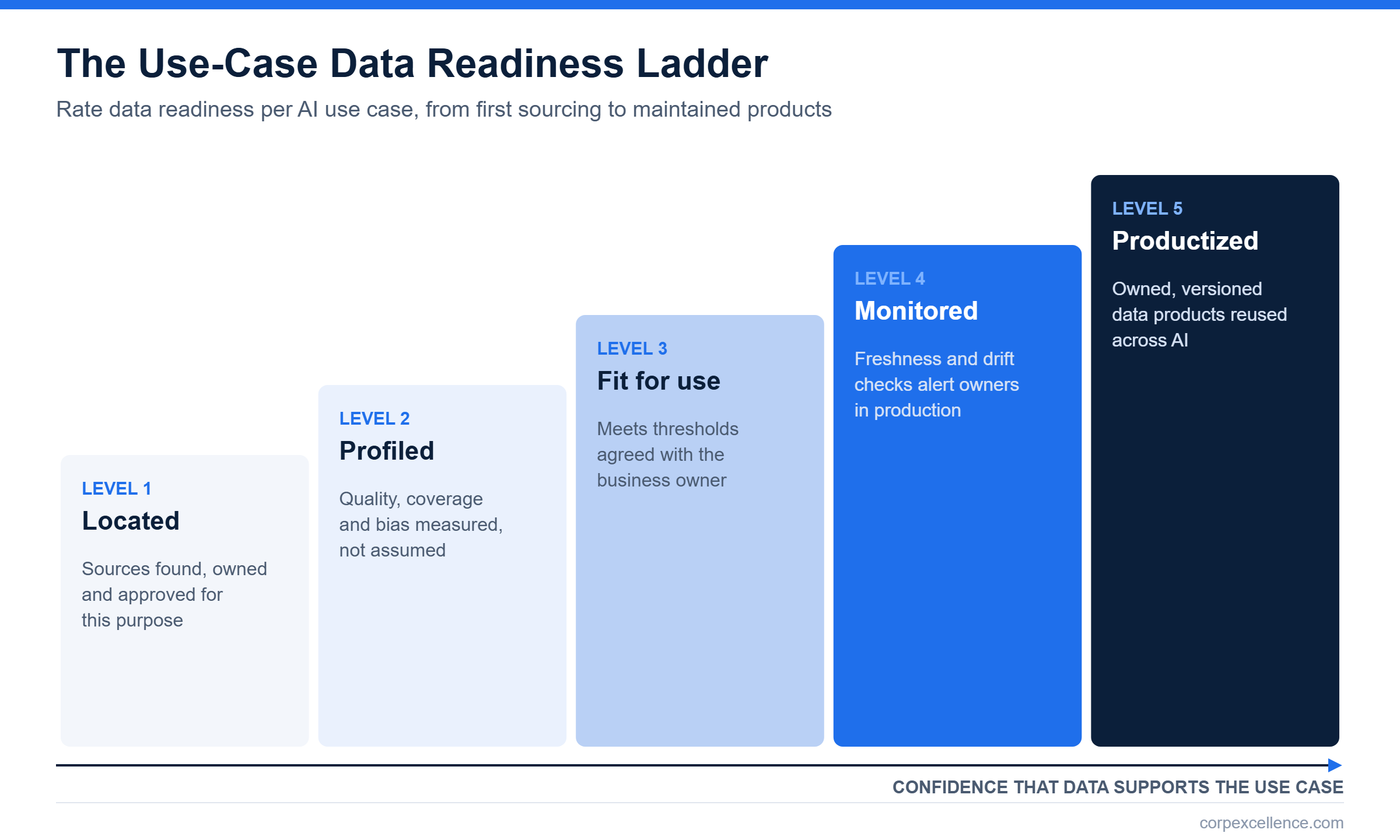
Readiness is a rating you give data for a specific use case, not a badge the data carries everywhere. The Use-Case Data Readiness Ladder is a CorpExcellence framework that places each AI use case on one of five rungs, from finding the right sources to running them as maintained products. A service assistant and a credit model can draw on the same customer records and sit on different rungs, because the stakes and the acceptable error rates differ.
Rungs one and two: find it, then measure it
At Located, the team knows which sources the use case needs, who owns each one and whether reuse for this purpose is approved. Many projects stall here because the data was collected for something else and no one can say who may approve the new use. At Profiled, quality has been measured rather than assumed. Profiling covers completeness, accuracy, consistency, timeliness and representativeness for the population the system will serve, plus a search for gaps and skew that could bias outcomes. The ISO/IEC 5259 series on data quality for analytics and machine learning offers shared terms and measures for this work.
Rung three: fit for use
Data is Fit for use when it meets thresholds the business owner agreed before the build started. Thresholds scale with risk: a drafting assistant can tolerate gaps that a hiring or lending model cannot. For generative AI, fitness applies to unstructured content as much as to tables:
- Documents are current, deduplicated and assigned to a named owner.
- Metadata records source, date, sensitivity and access rights, so retrieval respects permissions.
- Drafts and superseded versions are removed or clearly labeled.
- Evaluation sets exist to test answers against known-good sources.
Rungs four and five: keep it ready
Readiness decays as sources and business processes change. At Monitored, quality checks run inside production pipelines and alert owners when freshness, volume or distributions drift. At Productized, the data is packaged as an owned, versioned data product with a documented contract, so the next AI use case starts higher on the ladder instead of repeating the same cleanup.
Is your data ready for this use case, or just in general?
AI-Ready Data scores each use case across six dimensions against criticality levels C1 to C4, so thresholds tighten where errors cost the most.
Where the industry is now
As of September 2026, Article 10 of the EU AI Act requires training, validation and testing data for high-risk systems to be relevant, sufficiently representative and, to the best extent possible, free of errors and complete for the intended purpose. Regulation (EU) 2026/1744, the AI Omnibus, entered into force on July 27, 2026 and moved the application date for stand-alone high-risk systems to December 2, 2027, with product-embedded systems following on August 2, 2028. That time is best spent producing evidence for the Profiled and Fit for use rungs. Generative AI and agent projects have also shifted the hardest readiness work toward documents, tickets and knowledge bases, where ownership and metadata are usually weakest.
Common pitfalls
- Running one enterprise-wide readiness assessment instead of rating each use case.
- Indexing whole shared drives into a retrieval system without pruning or permission checks.
- Setting quality thresholds only after a model underperforms.
- Treating readiness as a project milestone rather than a monitored condition.
Research report
Assess and fix data for your next AI use case
The 56-page report includes a readiness assessment worksheet, a quality metric catalog, a representativeness checklist and five scenario playbooks.
New research report
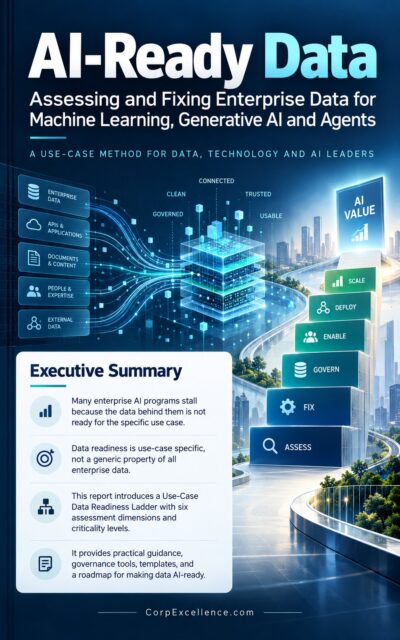
AI-Ready Data
56-page method for assessing and fixing enterprise data for machine learning, RAG and AI agents. Includes worksheets and templates.
Questions leaders should ask
- What data does each priority AI use case need, and is it fit for that purpose?
- Who owns the documents our AI assistants answer from?
- How much outdated or duplicate content would our AI see today?
- Are we fixing data problems at the source?
More in Data for AI
Related research reports
In-depth reports with ready-to-use templates.
- AI-Ready Data$59.99 PDF report
Latest Analysis: Data Quality & AI Readiness
Explore articles addressing this research topic as new analysis is published. The newest articles appear here automatically.
Related research reports
Reports connected to this topic.