Research · AI Strategy & Adoption
Business Case & ROI
An AI business case must survive the question every CFO asks: what will this cost, what will it return and how will we know? Credible cases count the full cost of ownership and measure outcomes, not activity.
The AI Value Ledger
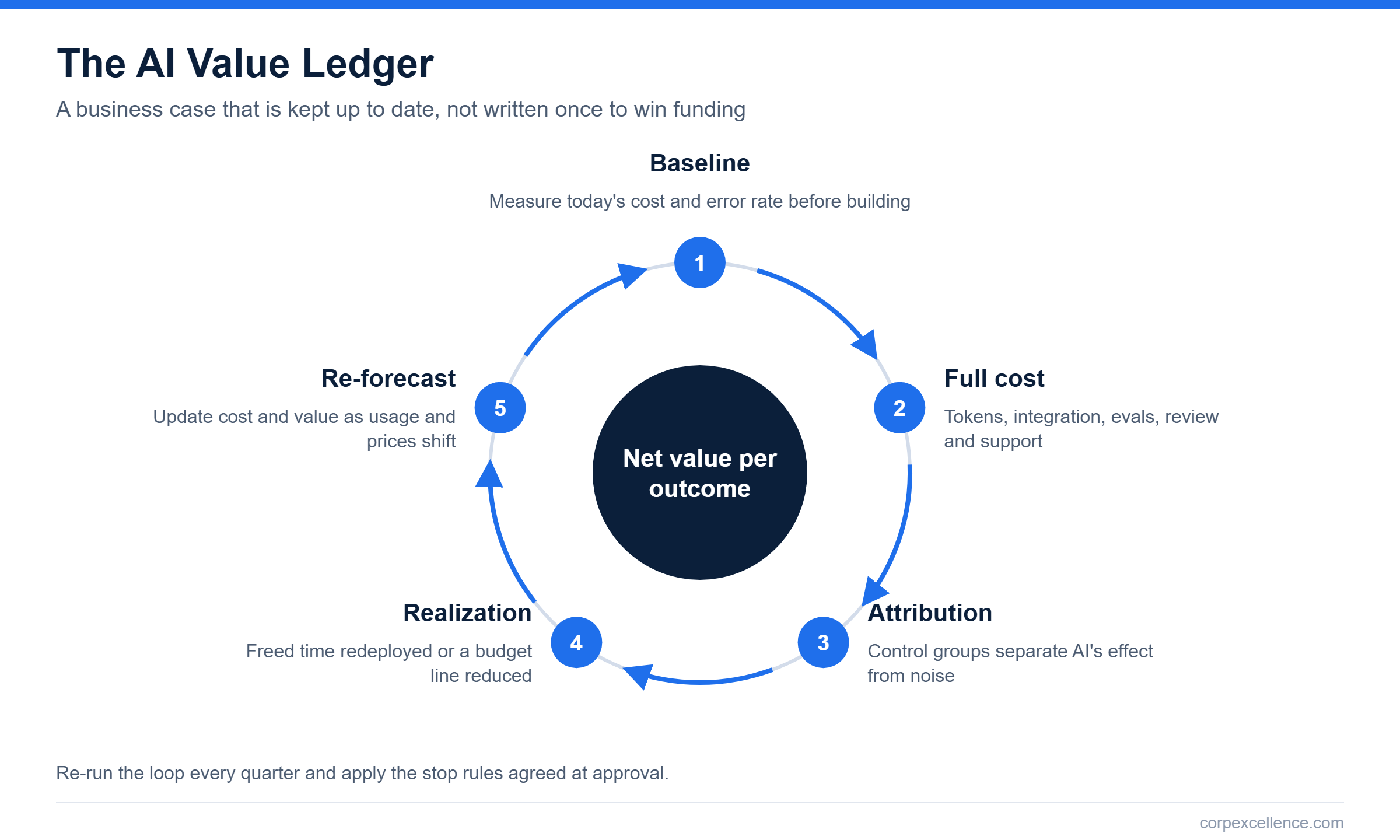
An AI business case is usually written once to win funding and then forgotten. The AI Value Ledger is a CorpExcellence framework that treats the case as a living account instead. It records what the process costs before AI, what the AI really costs to run, how much of the change the AI actually caused, and whether the benefit reached a budget line. Leaders update it each quarter, so the case that approved a project is the same one used to scale it or stop it.
1. Set the baseline before you build
Measure the current process first: cycle time, cost per transaction, error or rework rate, and the customer outcome you care about. Use figures you already report so finance trusts them. Without a baseline, every later benefit is an estimate presented as a result.
2. Count the full cost
Model and token charges are only the visible part. A complete cost line includes integration and data preparation, evaluation and red-teaming, human review of outputs, security and governance work, training, and the support that keeps prompts and connectors working as vendors update their models. Model the cost under at least two usage scenarios, because consumption, not license count, now drives most AI bills.
3. Attribute the change
Compare a group using the AI with a similar group that is not, over the same period. Where a control group is impossible, use a staggered rollout and compare early and late adopters. Agree on the measurement method with finance before the pilot starts, not after. Report adoption separately from outcomes. High usage shows interest, not value.
4. Confirm the value was realized
Saved time counts as a benefit only when it turns into something measurable: fewer contractor hours, volume growth absorbed without new hires, faster revenue or lower loss rates. Before launch, name the budget owner who will show the change in their own numbers. If no owner will commit, treat the benefit as unproven.
5. Re-forecast every quarter
Prices and usage patterns move quickly. Each quarter, update cost and benefit against the plan and apply the stop rules agreed at approval. A case that is never revised is a sales document.

Know the true cost of one successful transaction
AI Inference Cost Control gives you the cost-per-transaction method behind this ledger, with a worksheet, a cost-driver decomposition and an executive AI cost scorecard.
Where the industry is now
AI cost behavior has changed. The FinOps Foundation notes that per-token prices keep falling while reasoning and agentic workloads use many more tokens per task, so total spend often rises. Pricing models are shifting as well: Salesforce introduced consumption credits charged per agent action in 2025, and Intercom prices its AI agent per outcome. Cost per business outcome is now the most useful unit in a business case, because it can be compared directly with the baseline.
Common pitfalls
- Counting hours saved with no plan to redeploy them.
- Pricing the pilot and assuming production costs grow in a straight line.
- Leaving evaluation and human review out of the cost line.
- Approving a case with no stop rule.
Research report
Build the cost side of your AI business case
Get the 52-page playbook with fully loaded unit cost, quality-adjusted optimization, driver-based forecasting and a 90-day implementation roadmap.
Featured research report

AI Inference Cost Control
52-page FinOps playbook for production AI. Includes a cost-per-transaction worksheet, a model routing policy template and an AI spending governance control catalog.
Questions leaders should ask
- Which business metric will this AI investment move, and by how much?
- What happens to our costs if usage doubles?
- How will saved time be redeployed or captured?
- What result would make us stop?
More in AI Strategy & Adoption
Related research reports
In-depth reports with ready-to-use templates.
- AI Inference Cost Control$49.99 PDF report
- AI-Ready Data$59.99 PDF report
Latest Analysis: Business Case & ROI
Explore articles addressing this research topic as new analysis is published. The newest articles appear here automatically.
Related research reports
Reports connected to this topic.