
Disclaimer: This article is best-effort research based on public sources available as of October 2026. Details in this area change quickly, so verify facts against the primary sources listed at the end before acting.
October is when 2027 budgets start to harden, and this year the AI line is under more scrutiny than ever. Gartner forecast in May 2026 that worldwide AI spending will reach about $2.59 trillion in 2026, up roughly 47% on 2025. Most of that money is flowing to hyperscalers and infrastructure, not to enterprise projects. Gartner’s own analysts described enterprises as favoring tactical, incremental AI initiatives over transformation, and called 2026 the year enterprises would “really flex their spending potential.”
At the same time, the agentic AI projects many organizations launched in 2025 are reaching their first real budget review. Gartner predicted in June 2025 that over 40% of agentic AI projects will be canceled by the end of 2027 because of escalating costs, unclear business value or inadequate risk controls. If your organization runs a dozen agent pilots, the base rate says several will not make it. The question for this budget cycle is whether you choose which ones, or let cost overruns choose for you.
This article gives leaders a way to sort an agentic AI portfolio in a few working sessions, using evidence rather than vendor claims.
Why so many agent projects stall
The failure pattern is consistent across the research and across the pilots we see described in industry reporting. Three causes come up again and again.
Agent washing. Gartner estimated that only about 130 of the thousands of vendors marketing agentic AI offer real agentic capability. The rest relabel chatbots, robotic process automation or assistants. Buyers then pay agent prices, and carry agent risk, for tools that do not plan or act across systems. When the project is reviewed, the promised autonomy is missing and the business case collapses.
No baseline. Many pilots were approved on enthusiasm. Nobody measured the cost, cycle time or error rate of the workflow before the agent arrived, so nobody can prove the agent improved it. A pilot without a baseline can only be defended with anecdotes, and anecdotes do not survive a CFO review.
Weak foundations. Agents need clean, permissioned data and tightly scoped access to the systems they act on. In an April 2026 release, Gartner reported that organizations with successful AI initiatives invest up to four times more, as a share of revenue, in data and analytics foundations than organizations with poor AI outcomes. The same survey found only 39% of technology leaders were confident their AI investments would improve financial performance. Projects built on weak data stall at the point where they need to touch production systems.
The Agent Portfolio Triage Grid
The fastest way to make better budget decisions is to place every agentic project on two axes: how strong the evidence of value is, and how ready the project is for production. Readiness here means four things: the data is owned and usable, tool access is scoped and logged, security has reviewed it, and a business owner is accountable.
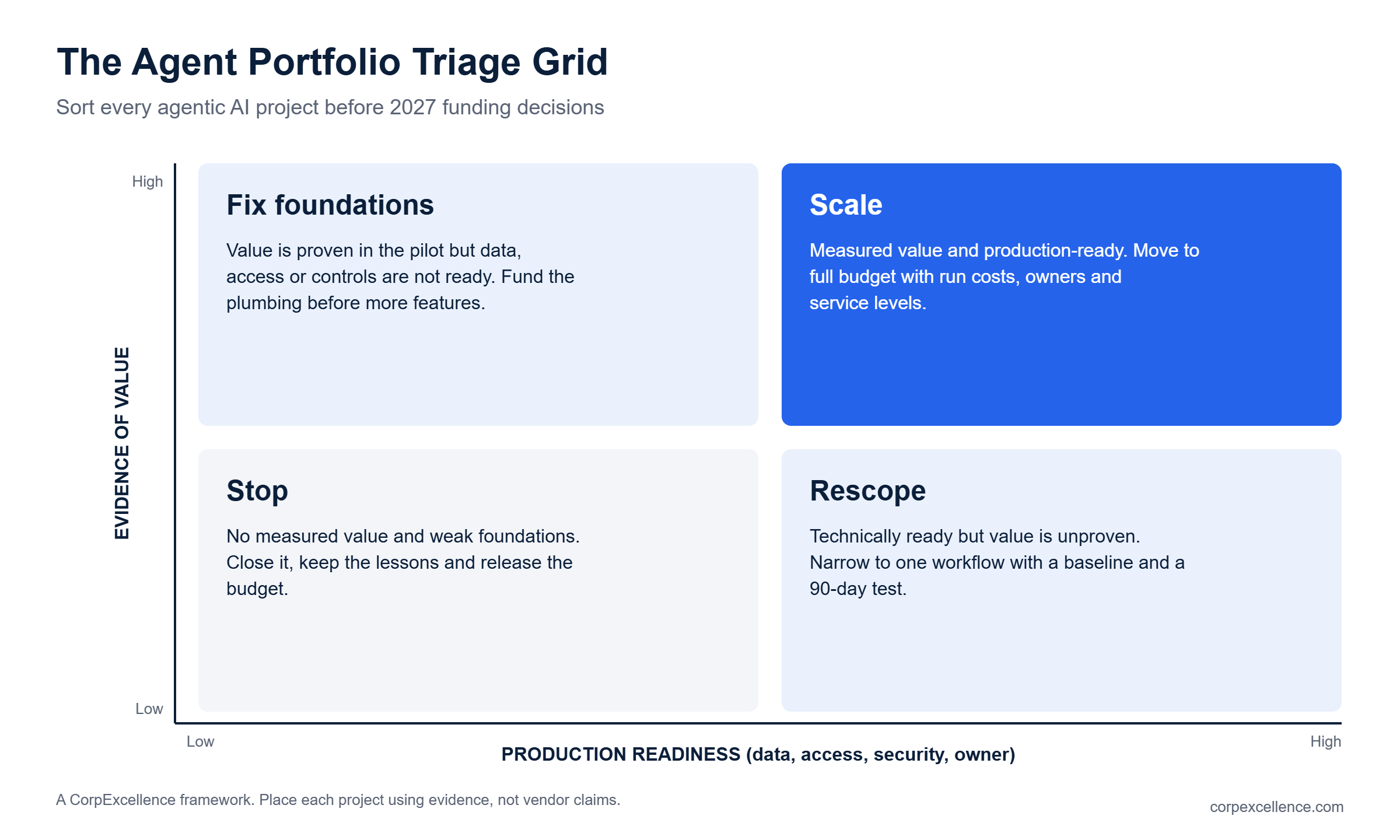
Scale projects have measured value and are ready for production. Fund them properly, including run costs, monitoring, support and an owner. Underfunding the run phase is a common way to turn a success into a cancellation a year later.
Fix foundations projects have shown value in a pilot, but data, access or controls are not ready. Resist the urge to add features. Fund the data work, access design and security review first, and set a date to re-assess.
Rescope projects work technically, but nobody has shown they pay off. Narrow each one to a single workflow, measure a baseline, and run a time-boxed test of about 90 days with a clear success threshold.
Stop projects have neither evidence nor foundations. Close them, write down what was learned and release the budget. Stopping a weak project early is a sign of discipline, not failure. It also frees funds for the Fix and Scale columns.
Four gates before an agent gets 2027 funding
Placement on the grid tells you where a project stands. The gates below decide whether it receives new money. Apply them in order and send any project that fails a gate back to the grid.
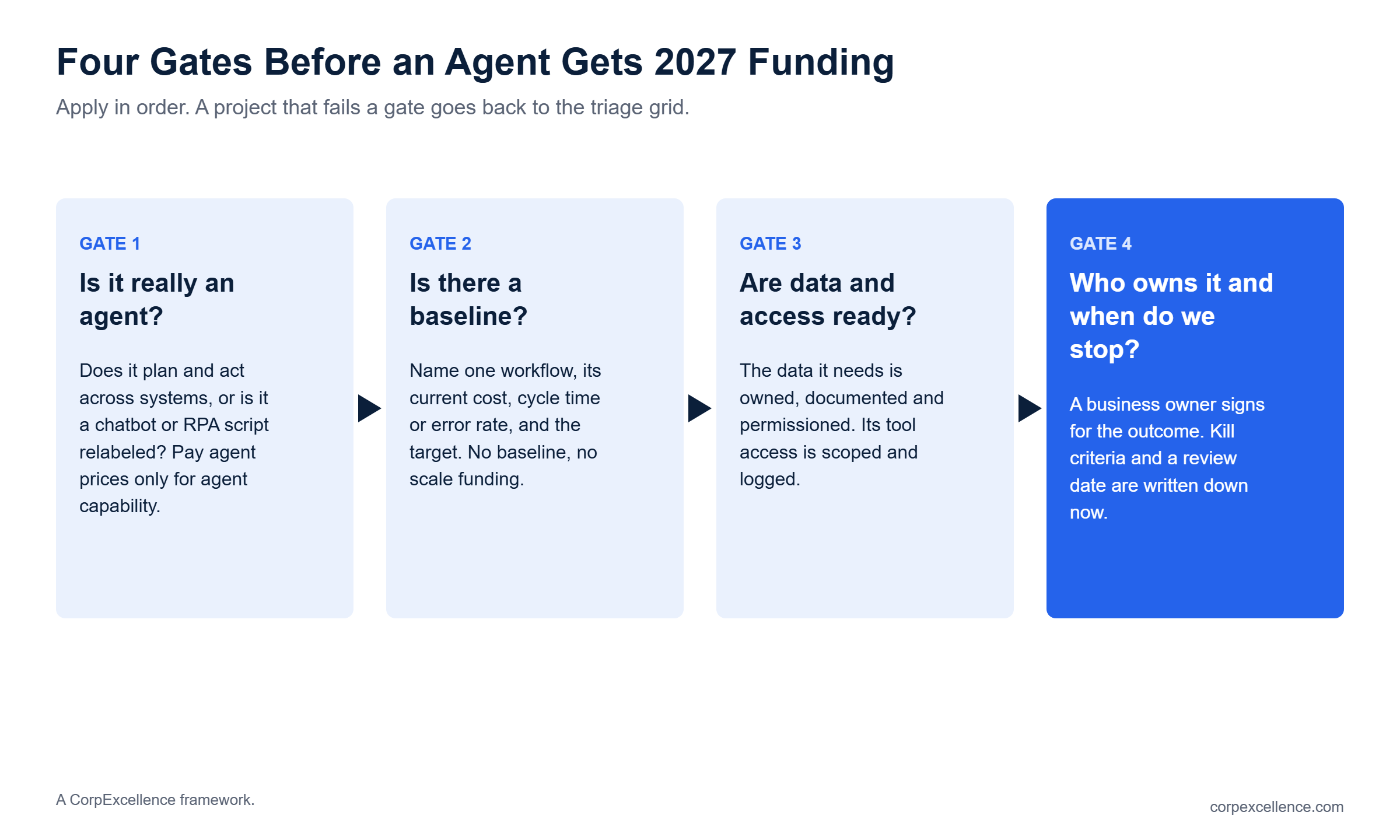
Gate 1: Is it really an agent? Ask the vendor or internal team to show the system planning a multi-step task and acting across at least two systems with appropriate approvals. If it only answers questions or runs a fixed script, it may still be useful, but it should be priced and governed as what it is.
Gate 2: Is there a baseline? Name one workflow, its current cost, cycle time or error rate, and the target improvement. Our research on building an AI business case covers how to structure this so finance will accept it.
Gate 3: Are data and access ready? The data the agent needs should have an owner, a documented meaning and access controls. Its tool permissions should follow least privilege, with every action logged. See data quality and AI readiness for a use-case-based test.
Gate 4: Who owns it and when do we stop? A named business owner signs for the outcome. Kill criteria and a review date are written into the funding approval. This single step prevents most zombie projects.
Running the triage in practice
A workable cadence for most mid-size and large organizations looks like this:
- Week 1: Inventory. List every project that uses agentic AI, including features switched on inside SaaS products. Record owner, spend to date, run-rate cost and the workflow it touches.
- Week 2: Evidence review. For each project, collect the baseline and the measured result. Where there is none, mark the evidence axis low. Do not accept projected benefits as evidence.
- Week 3: Readiness review. Security, data and architecture leads score readiness together. Use the Bounded Agent Stack to check autonomy limits and permissions.
- Week 4: Decisions. Place projects on the grid, apply the gates and publish the result with reasons. Transparency reduces lobbying and makes next year’s review easier.
Keep a reserve. Gartner also predicted in its 2025 research that by 2028 a third of enterprise software applications will include agentic AI. Many of your agents will arrive inside software you already license. Holding part of the AI budget for evaluating and governing those embedded agents is more realistic than assuming every agent will be a custom build.
What to tell the board
Boards do not need the grid. They need three numbers: how much AI spend is in each quadrant, what measured value the Scale projects delivered, and what risk controls are in place before anything moves to production. Presenting a portfolio that includes stopped projects builds credibility. It shows the organization is managing AI as an investment, not a fashion.
For organizations putting agents into production, our report Governing Agentic AI 2026 provides autonomy levels, risk tiers and templates that fit directly into Gates 3 and 4. For the cost side of Scale decisions, see AI cost management.
Sources
- Gartner, “Gartner Predicts Over 40% of Agentic AI Projects Will Be Canceled by End of 2027,” press release, 25 June 2025. gartner.com
- Gartner, “Gartner Says Organizations with Successful AI Initiatives Invest Up to Four Times More in Data and Analytics Foundations,” press release, 16 April 2026. gartner.com
- CIO Dive, “Global AI spend to reach $2.59 trillion in 2026,” 19 May 2026, reporting Gartner’s forecast. ciodive.com