Research · AI Strategy & Adoption
Use Case Prioritization
Every organization has more AI ideas than capacity to deliver them. Use case prioritization is the discipline of choosing the few that will produce measurable value, can be delivered safely and teach the organization something it can reuse.
A framework for choosing well
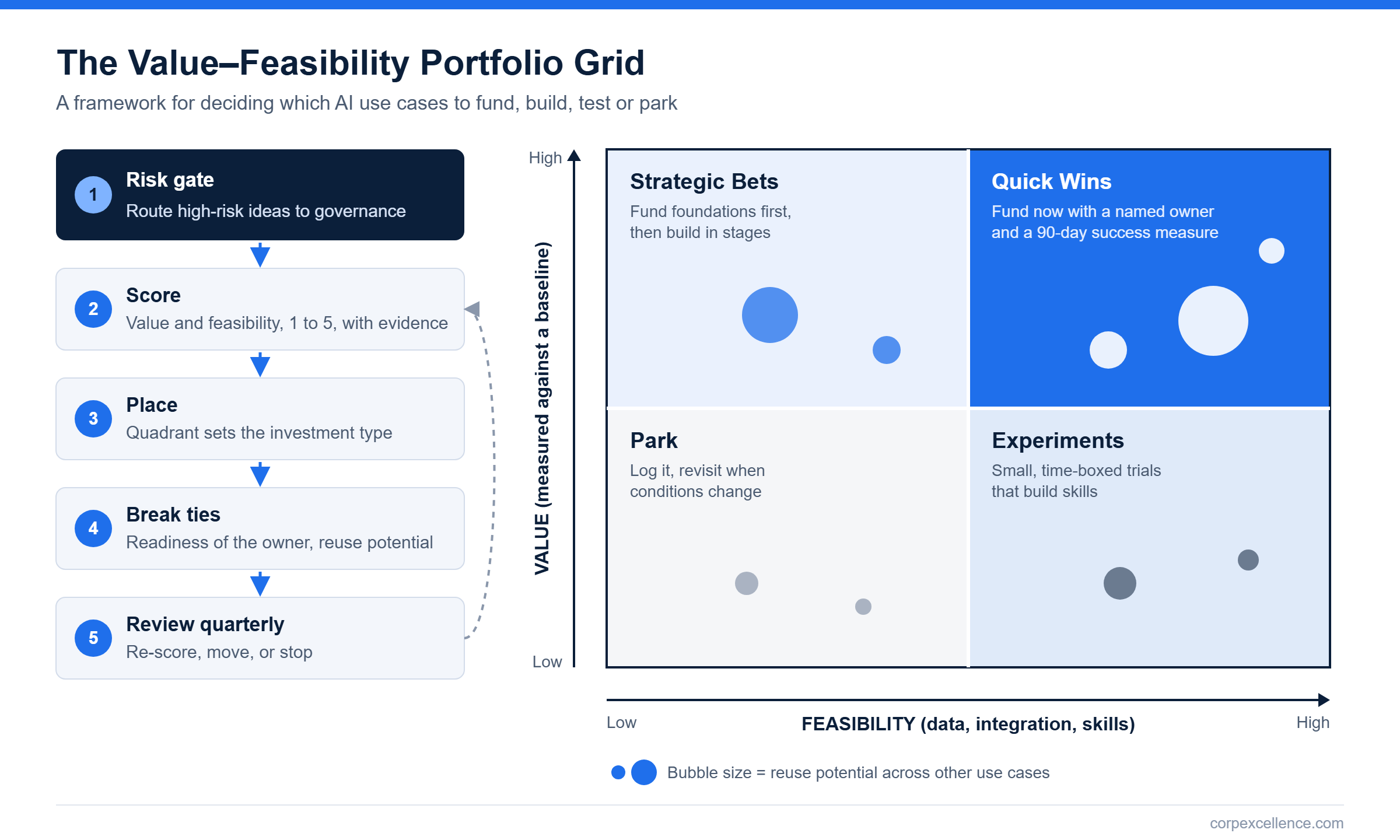
Most organizations score AI ideas once, rank them and move on. The Value–Feasibility Portfolio Grid is a CorpExcellence framework that turns scoring into a repeatable portfolio decision. Each idea is screened for risk first, then placed on a grid that tells leaders what kind of investment it deserves.
Step 1: Pass the risk gate
Before any scoring, each use case answers a short set of screening questions. Will the AI make or materially shape decisions about customers or employees? Will it process regulated or confidential data? Can a qualified person check the output before it takes effect? Can it act on its own in other systems, as an agent with tool access does? For EU exposure, does it fall into a prohibited or high-risk category under the AI Act? A use case that raises concerns is not rejected. It moves to a governance review where controls are designed before it competes for funding.
Step 2: Score value and feasibility
Value is the size of the problem in revenue, cost, risk reduction or customer experience, measured against a baseline you can track today. Feasibility is whether you have the data and the skills to deliver, and whether the run cost holds up at production volume. Agentic workloads can make a cheap pilot expensive at scale. Score each on a 1 to 5 scale and require one sentence of evidence for every score. Evidence makes scores easier to challenge in review.
Step 3: Place it on the grid
- Quick Wins (high value, high feasibility): fund now, with a named owner and a 90-day success measure.
- Strategic Bets (high value, low feasibility): fund the foundations first, usually data or integration work, and release the full build in stages.
- Experiments (low value, high feasibility): allow small, time-boxed trials that build skills. Stop them if they do not earn a higher value score.
- Park (low value, low feasibility): log the idea and revisit it when conditions change.
Step 4: Break ties with readiness and reuse
When two use cases land in the same quadrant, two questions decide the order. Is there a business owner who wants this, with a process that can absorb the change? Will the data or platform it creates serve other use cases? On the grid, bubble size shows reuse potential. Larger bubbles usually go first.
Step 5: Review the portfolio every quarter
A use case’s position changes as data matures and as regulation evolves. Re-score active use cases each quarter and move them when the evidence supports it. Stop pilots that missed their targets.
Where the industry is now
As of September 2026, two shifts change how portfolios are scored. Many new use cases are agents rather than assistants, which raises the stakes at the risk gate. In the EU, the Digital Omnibus on AI moved most high-risk obligations to December 2, 2027 (see the European Commission’s AI Act page). That is more time to prepare, not a reason to skip classification.
Common pitfalls
- Choosing use cases because a vendor demo looked impressive.
- Scoring value without a baseline to measure against.
- Treating the risk gate as paperwork rather than a design step.
Questions leaders should ask
- What baseline will we measure each AI use case against?
- Which of our pilots should we stop?
- Does each funded use case have a business owner who wants it?
- Which use cases build capabilities we can reuse?
More in AI Strategy & Adoption
Related research reports
In-depth reports with ready-to-use templates.
- AI-Ready Data$59.99 PDF report
Latest Analysis: Use Case Prioritization
Explore articles addressing this research topic as new analysis is published. The newest articles appear here automatically.
Related research reports
Reports connected to this topic.