
Foundations Series
AI, Tech, and Careers
AI is changing enterprise IT in two ways at once: how IT teams do their work, and the kind of systems they deliver. This ten-part Foundations series follows that change in order. It starts with what shifts when software stops being fully predictable and how AI affects the development lifecycle. It then covers what it takes to move AI from demo to production and where AI fits in the enterprise technology stack. Later articles examine the authority AI agents should hold and the economics behind a credible business case, followed by the controls that make an AI service trustworthy. The series closes with what AI could mean for IT careers and what IT professionals should learn next. Each article is written for technology leaders and practitioners who need a practical basis for decisions.
AI and Tech: Foundations
AI is changing enterprise technology in two ways at once. It is becoming a component inside the systems organizations build, and it is becoming a tool that changes how those systems are designed and operated. Both shifts reach the people who do the work. This page collects CorpExcellence.com articles and reports on what these changes mean for IT organizations and for the careers of people who work in technology.
Why a careful view matters
The evidence so far is uneven, and headlines rarely reflect that. In Stack Overflow’s 2026 Developer Survey, about two-thirds of developers who use AI reported using coding agents, yet only about one in five used AI to deploy, operate or troubleshoot production systems. Google’s 2025 DORA research found that AI tends to amplify a team’s existing strengths and weaknesses: delivery throughput rose with AI adoption, while delivery stability tended to suffer. On careers, an August 2026 update of a Stanford Digital Economy Lab study found no widespread job displacement. It did find that employment of workers aged 22 to 25 in the most AI-exposed occupations had fallen well behind that of comparable workers, mainly because fewer were hired. These findings point in different directions, and readers deserve analysis that keeps them separate.
What this page covers
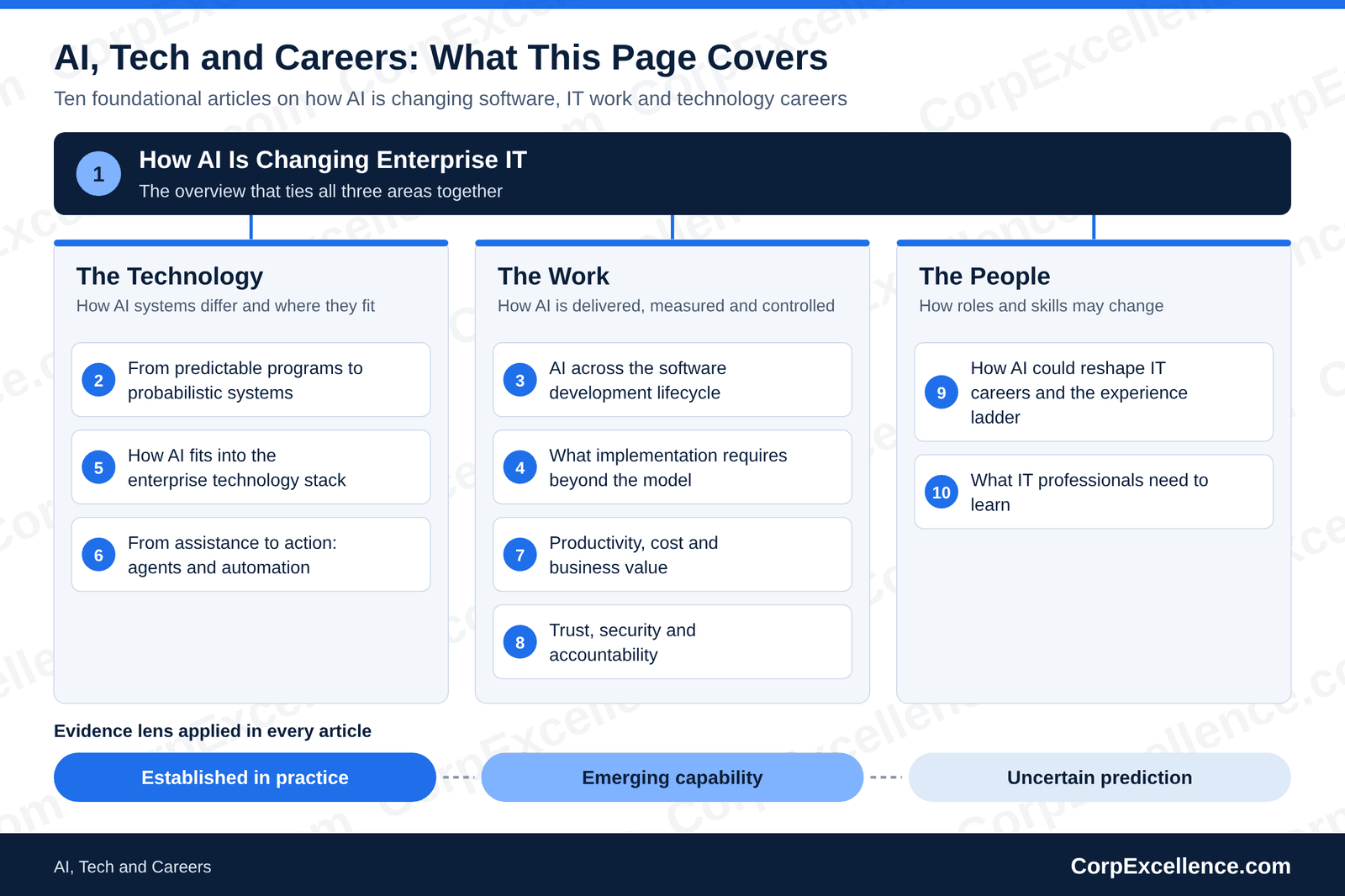
The articles are organized into three areas, connected by an overview of how AI is changing enterprise IT.
- The technology. How software that relies on AI models differs from conventional programs, where AI fits in the enterprise technology stack, and the range from assistants that suggest to agents that act.
- The work. How AI enters each stage of software delivery, what a dependable implementation requires beyond the model, how to measure productivity and business value honestly, and the security and accountability controls that make AI safe to rely on.
- The people. How tasks and roles may shift for developers, testers, analysts, architects, project managers, security specialists and operations teams, including the effect on the entry-level path into the profession, and what IT professionals should learn as their work changes.
Planning your next credential?
AI Certifications and Career Pathways maps certifications and courses to IT roles, with suggested pathways and a personal decision worksheet.
How we approach the subject
Every article applies the same evidence lens. We separate what is established in practice from capabilities that are still emerging, and both from predictions that remain uncertain. We distinguish time saved on a task from value delivered to the business, and the automation of tasks from the loss of jobs. We focus on principles that hold as tools change, rather than product rankings that date within months, and we revise articles as better evidence appears.
The page is written for CIOs, CTOs, engineering and delivery leaders, architects, and IT professionals planning their next step. Start with the overview, then follow the area that matches your role or your next decision.
CorpExcellence.com publications are prepared on a best-effort basis from sources believed reliable at the time of writing. AI technology, practices and evidence change quickly, so readers should confirm current details before relying on them.
Part 1 of 10
How AI Is Changing Enterprise IT: The Technology, the Work, and the People
New AI tools can arrive as a subscription, but useful change in enterprise IT depends on decisions about delivery, operations, and accountability.
Part 2 of 10
From Predictable Programs to Probabilistic Systems: What Changes When Software Uses AI?
When learned behavior enters the decision path, the basis for trusting an output changes. Here is how to design, test, and support it.
Part 3 of 10
How AI Changes the Software Development Lifecycle: From Requirements to Production
A faster draft matters only in relation to the reviews, dependencies, and operational consequences around it. Follow AI through the full lifecycle.
Part 4 of 10
Beyond the Model: What Enterprise AI Implementation Actually Requires
A model is one component. Six readiness questions turn a promising demo into a service that keeps working in production.
Part 5 of 10
How AI Fits into the Enterprise Technology Stack
Separate the components of an enterprise AI application by responsibility to make architecture and buying decisions clearer.
Part 6 of 10
From Assistance to Action: Understanding AI Agents and Automation
An assistant that drafts an email and a system that sends it do not have the same authority. Define what an agent may decide and do.
Part 7 of 10
The Economics of AI in IT: Productivity, Cost, and Business Value
Time saved, capacity released, and money saved are different outcomes. A credible AI investment case explains the connection.
Part 8 of 10
Trust, Security, and Accountability: The Foundations of Responsible AI Delivery
Trust in an AI service requires examining correctness, protection, and accountability separately, with evidence that boundaries are enforced.
Part 9 of 10
How AI Could Reshape IT Careers: Tasks, Roles, and the Experience Ladder
Tools change tasks, but employers decide how roles, staffing, and training respond. Here is how to read the evidence on IT careers.
Part 10 of 10
What IT Professionals Need to Learn as AI Changes Their Work
The goal is not to master every new tool but to become better at delivering and evaluating work as the tools change.