Research · Generative & Agentic AI
Copilots & Assistants
Copilots and AI assistants bring generative AI into the tools people already use: email, documents, meetings, code editors, CRM and service desks. Rollout success depends as much on data permissions and training as on the tool.
The Copilot Value Ladder
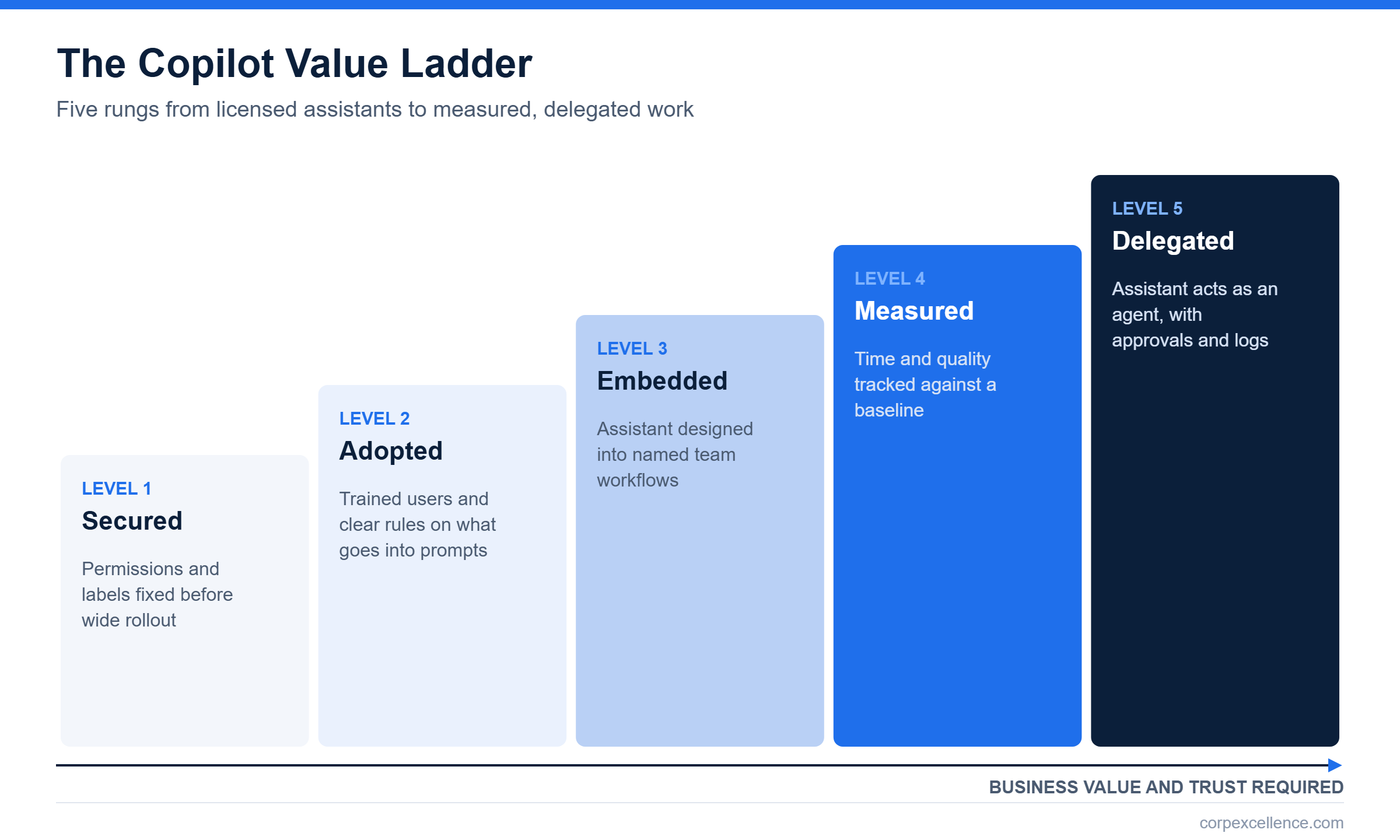
Buying copilot licenses is easy. Getting value from them takes longer, and rollouts tend to stall at the same points. The Copilot Value Ladder, a CorpExcellence framework, describes five rungs an organization climbs as assistants move from a pilot to part of how work gets done. Each rung has a gate that should be passed before moving up. Skipping a gate is how rollouts end up with exposed data or idle licenses.
Rungs 1 and 2: secured, then adopted
An assistant can surface anything the signed-in user is allowed to open. If files are overshared, the assistant makes that oversharing easy to find. Fix permissions and apply sensitivity labels before broad rollout, and restrict search on high-risk sites in the meantime. Assign the cleanup to data owners, since IT rarely knows which sharing is intended. Microsoft’s deployment blueprint for Copilot puts remediating oversharing first for the same reason.
Adoption then depends on people more than on licenses. Users need role-based training and a clear policy on what data may go into prompts. They also need the habit of checking outputs before sharing them. Track active use per license and reassign seats that sit idle.
Rungs 3 and 4: embedded, then measured
General-purpose chat produces scattered gains. Value concentrates when an assistant is built into a specific workflow, such as drafting service desk replies or writing tests in the code editor. Choose a small number of workflows with clear owners and design the assistant’s role in each one.
Measure at the workflow level. Pick a baseline, such as handling time or rework rate, and compare it with assisted work over several weeks. Vendor dashboards show usage. They rarely show whether the work got better. Retire or redesign workflows where the assistant adds review effort without saving time.
Rung 5: delegated
Assistants increasingly act instead of suggesting. Coding assistants can take an assigned task, make changes on a branch and hand the result back for review. GitHub’s Copilot cloud agent, for example, works in its own isolated environment and is subject to branch protection rules. Delegation needs the same controls described on our AI agents page: scoped permissions and human approval before any irreversible action, with every step logged. Start with low-risk tasks where a person reviews the output before it takes effect.
Where the industry is now
As of September 2026, the main shift is from copilots that answer to copilots that take actions inside business systems. Builders can now connect assistants to business tools through the Model Context Protocol (MCP); Microsoft Copilot Studio is one platform that supports it. That raises the stakes on the lower rungs. An assistant with write access inherits every permissions mistake left unfixed at rung one.
Common pitfalls
- Rolling out to everyone before fixing oversharing.
- Counting assigned licenses as adoption.
- Letting vendors switch on new agent features by default without review.
- Treating fluent output as verified output.
Research report
When a copilot starts acting on its own, governance has to change
Governing Agentic AI 2026 covers delegated agents: autonomy per action class, one identity per agent, human approval that holds up and tested kill switches, with 10 ready-to-use templates.
Featured research report
Governing Agentic AI 2026
67-page playbook for governing enterprise AI agents: autonomy levels, risk tiers, agent identity, MCP controls and human oversight. Includes 10 ready-to-use templates.
Questions leaders should ask
- Could our assistant surface documents to people who should not see them?
- What share of assistant licenses are actively used?
- Which vendor products have AI assistants switched on today?
- How do users verify what the assistant tells them?
More in Generative & Agentic AI
Related research reports
In-depth reports with ready-to-use templates.
- Governing Agentic AI 2026$59.99 PDF report
- Third-Party AI Risk$59.99 PDF report
Latest Analysis: Copilots & Assistants
Explore articles addressing this research topic as new analysis is published. The newest articles appear here automatically.
Related research reports
Reports connected to this topic.