Research · Generative & Agentic AI
RAG & Knowledge Systems
Retrieval-augmented generation (RAG) connects AI models to your own documents and data so answers are grounded in approved sources. For most enterprise knowledge use cases, the quality of retrieval matters more than the choice of model.
The Knowledge Grounding Loop
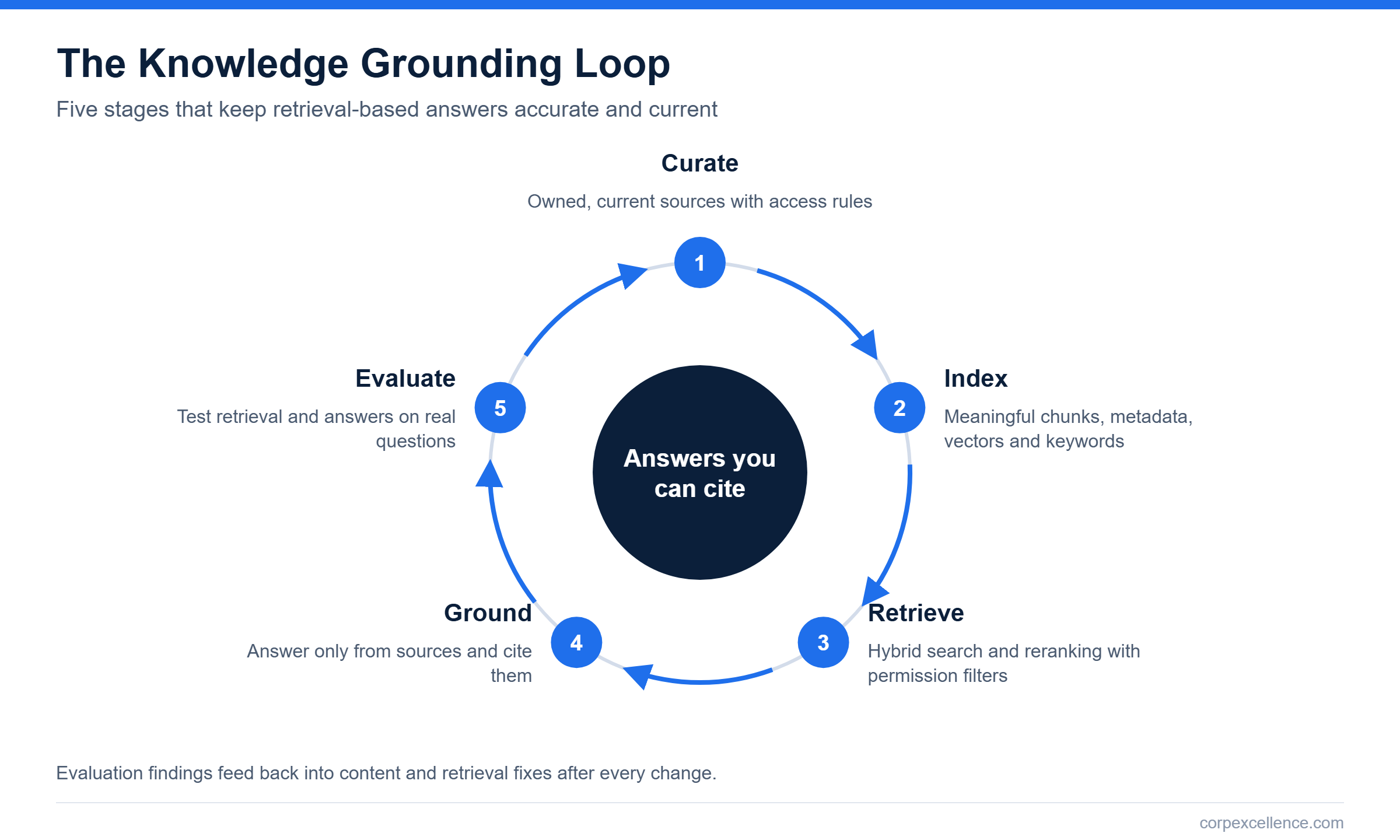
Retrieval-augmented generation (RAG) fails quietly. When retrieval misses the right document, the model still produces a fluent answer, so problems surface as user complaints rather than errors. The Knowledge Grounding Loop, a CorpExcellence framework, treats a RAG system as five stages that feed each other. Evaluation results flow back into content and retrieval fixes, which is why the work does not end at launch.
Curate and index
Start with content, not technology. Assign each content domain to a business owner who approves what goes in. Every source needs a named owner and a review date, and its access rules must carry forward into the index. Remove duplicates and outdated versions before indexing, because retrieval cannot tell which of two conflicting policies is current. Indexing then splits documents into passages that keep their meaning, tags them with metadata such as date and permission group, and stores both vector embeddings and a keyword index.
Retrieve and ground
Hybrid retrieval, which combines keyword and semantic search and then reranks the results, has become a common baseline. Product codes and policy numbers need exact matching, while questions in plain language need semantic matching. Test chunk size and the number of passages retrieved on your own documents rather than copying defaults. Permission filters must apply at query time so users retrieve only what they could open directly. Grounding instructs the model to answer only from retrieved passages and to cite them. When the sources do not cover the question, the answer should say so.
Evaluate
Build a test set from real user questions with known correct sources. Measure retrieval and generation separately: did the system find the right passages, and did the answer stay faithful to them? Re-run the set after every change to content, chunking, models or prompts. Track the share of questions the system declines to answer, since a rising rate often signals missing or stale content. Treat retrieved documents as untrusted input, since a planted instruction in a document can steer the model. OWASP’s Top 10 for LLM Applications lists prompt injection and vector and embedding weaknesses as named risks.
RAG answers are only as good as the content behind them
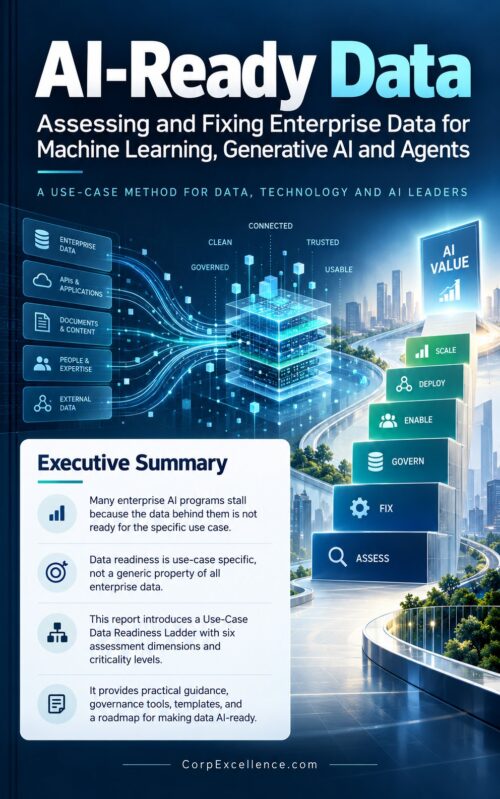
AI-Ready Data covers RAG failure points and data-side fixes, common content defects, permission checks and a content readiness checklist for retrieval-augmented generation.
Where the industry is now
As of September 2026, many teams are moving from single-pass pipelines to agentic RAG, where an agent rewrites queries and runs further searches when the first results fall short. A 2025 survey of agentic RAG describes how agents add planning and tool use to retrieval. Knowledge sources are also being exposed to agents through MCP servers. Both trends make the loop more important, because each extra retrieval step is another place for a wrong or unauthorized document to enter an answer. Before adding agentic steps, confirm that single-pass retrieval meets your test set baseline.
Common pitfalls
- Indexing an entire file share without cleaning it first.
- Checking permissions only at ingestion and not at query time.
- Judging quality from a demo instead of a test set.
- Changing the embedding model without re-running evaluations.
Research report
Prepare your content before you launch an assistant
The 56-page report shows how to curate and permission-check content for RAG and enterprise search, with a ready-to-use content readiness checklist.
New research report
AI-Ready Data
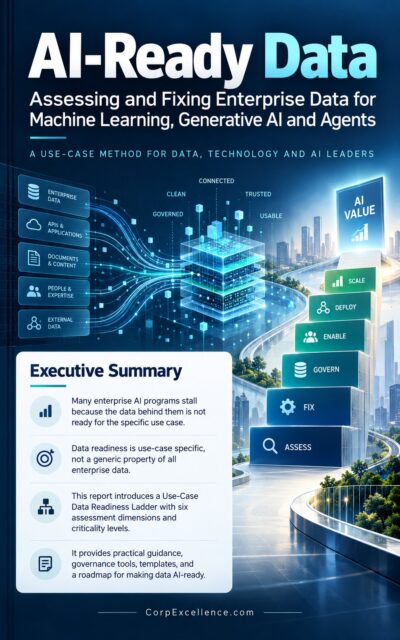
56-page method for assessing and fixing enterprise data for machine learning, RAG and AI agents. Includes worksheets and templates.
Questions leaders should ask
- Who owns the accuracy of the content our AI answers from?
- Does retrieval respect each user’s permissions?
- How do users see the sources behind an answer?
- How do we measure retrieval and answer quality?
More in Generative & Agentic AI
Related research reports
In-depth reports with ready-to-use templates.
- AI-Ready Data$59.99 PDF report
Latest Analysis: RAG & Knowledge Systems
Explore articles addressing this research topic as new analysis is published. The newest articles appear here automatically.
Related research reports
Reports connected to this topic.