Research · AI Governance, Risk & Compliance
Frameworks & Standards: NIST AI RMF and ISO/IEC 42001
Voluntary frameworks and international standards give organizations a common structure for AI governance. The NIST AI Risk Management Framework and ISO/IEC 42001 are the two most widely referenced.
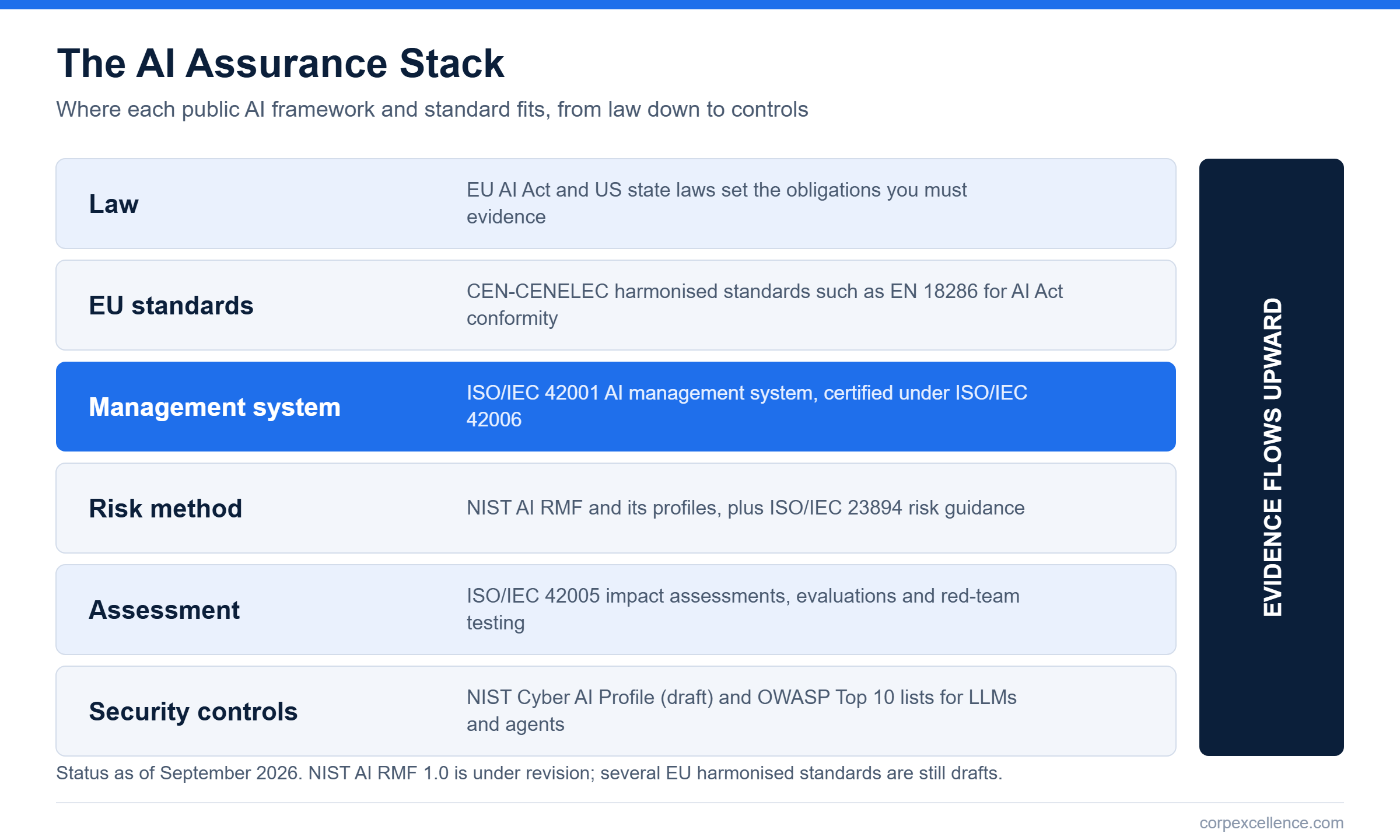
The AI Assurance Stack
Programs rarely stall for lack of frameworks. They stall when frameworks sit side by side with no clear link to each other or to the law. The AI Assurance Stack is a CorpExcellence model that places each public framework and standard in its own layer. Lower layers produce evidence and upper layers consume it, so a test result at the bottom can support a legal obligation at the top. Each layer names the standard it relies on, because none of these documents belongs to us.
Law and harmonised standards
Laws set outcomes, not methods. In the EU, CEN-CENELEC Joint Technical Committee 21 is writing harmonised standards that turn AI Act requirements into testable clauses. Once a standard is cited in the Official Journal, following it gives a presumption of conformity. EN 18286 on quality management was approved in July 2026, while prEN 18228 on AI risk management was still in draft. US state laws generally do not require a specific standard, so a multi-state program should map each state duty to evidence the EU layers already produce.
Management system
ISO/IEC 42001:2023 specifies an AI management system covering policy, roles, risk treatment, internal audit and management review. Its structure mirrors ISO/IEC 27001, so security and compliance teams can extend existing processes instead of building parallel ones. ISO/IEC 42006:2025 sets requirements for the bodies that audit and certify against 42001, which gives buyers firmer grounds to trust a certificate. Certification is optional. An organization can adopt the 42001 structure first and decide on an external audit once its controls have run for a full cycle.
Risk method and assessment
The NIST AI RMF supplies a shared risk vocabulary and four functions: Govern, Map, Measure and Manage. Its Generative AI Profile (NIST AI 600-1, July 2024) adds risks specific to generative models. ISO/IEC 23894:2023 gives risk management guidance, and ISO/IEC 42005:2025 guides impact assessments on individuals, groups and society. Testing also belongs in this layer: evaluations and red-team exercises that show whether controls actually work.
Security controls
The base layer is technical. NIST released a preliminary draft Cyber AI Profile (NIST IR 8596) in December 2025 that maps AI security to the Cybersecurity Framework. OWASP maintains Top 10 lists for LLM applications, refreshed in 2026, and for agentic applications. These give engineers concrete controls for prompt injection, excessive agent permissions and data leakage.
Where the industry is now
As of September 2026, NIST states that AI RMF 1.0 is being revised under the White House AI Action Plan, and it released a concept note for a critical infrastructure profile in April 2026. Treat the current version as stable for program design, but budget for a mapping update when the revision is published.
Common pitfalls
- Pursuing 42001 certification before a complete AI inventory exists.
- Running NIST and ISO efforts with separate owners and duplicate evidence.
- Assuming a certificate proves compliance with the EU AI Act or a state law.
Research report
Map agent controls to ISO/IEC 42001, the NIST AI RMF and OWASP once
Governing Agentic AI 2026 includes a crosswalk from its Six-Plane Agent Control Model to ISO/IEC 42001, the NIST AI RMF, the OWASP agentic list and MITRE ATLAS, plus a model agent governance policy.
Featured research report
Governing Agentic AI 2026
67-page playbook for governing enterprise AI agents: autonomy levels, risk tiers, agent identity, MCP controls and human oversight. Includes 10 ready-to-use templates.
Questions leaders should ask
- Which framework will we use as our common vocabulary for AI risk?
- Do customers or regulators expect ISO/IEC 42001 certification from us?
- Can we integrate AI governance into our existing ISO or risk programs?
- How do our framework controls map to the laws that apply to us?
More in AI Governance, Risk & Compliance
Related research reports
In-depth reports with ready-to-use templates.
- Governing Agentic AI 2026$59.99 PDF report
- Third-Party AI Risk$59.99 PDF report
Latest Analysis: Frameworks & Standards
Explore articles addressing this research topic as new analysis is published. The newest articles appear here automatically.
Related research reports
Reports connected to this topic.