Research · AI Governance, Risk & Compliance
AI Risk Assessment
An AI risk assessment identifies what could go wrong with a specific AI system, how likely and severe it would be, and what controls reduce it. It turns governance principles into decisions about a real system.
The AI Risk Assessment Loop
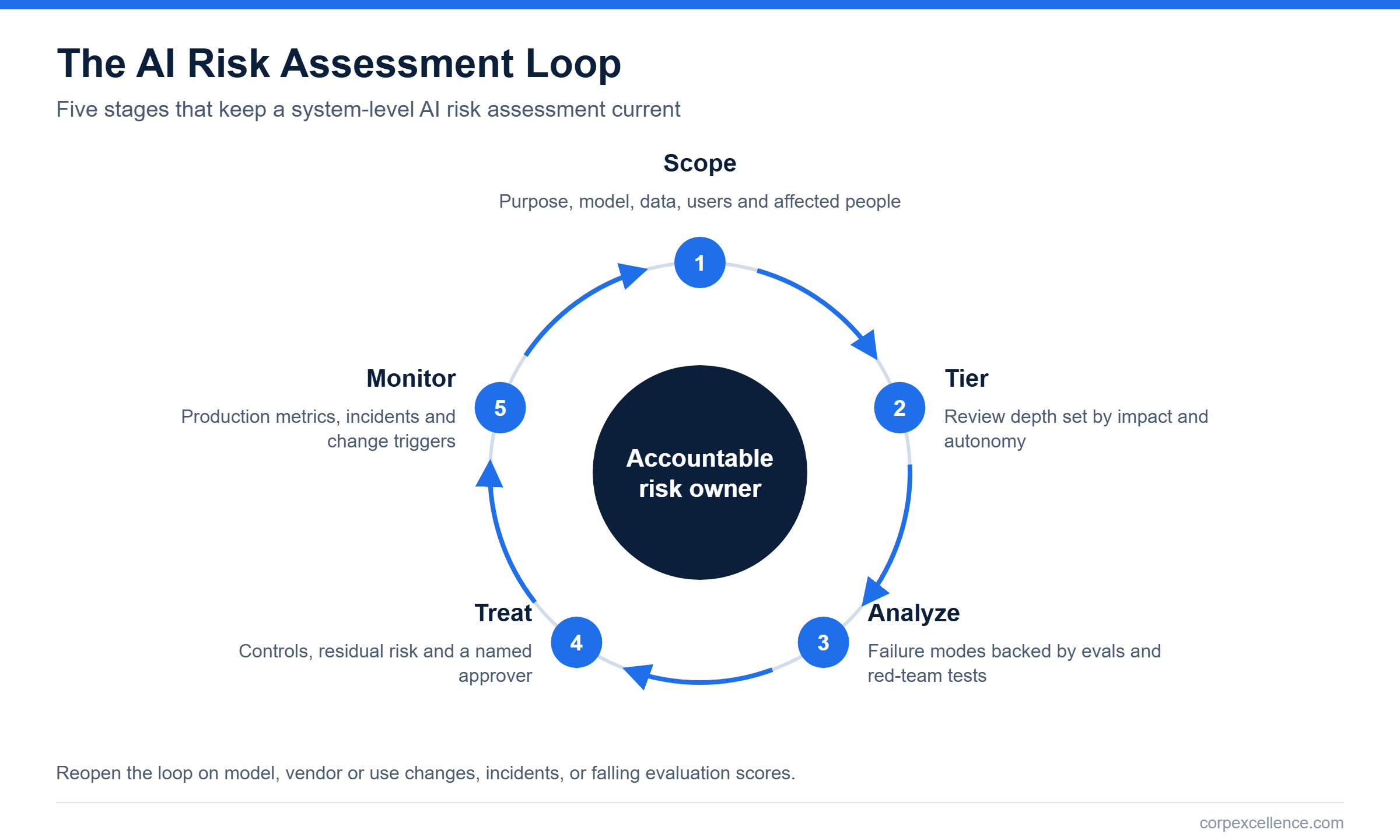
A risk assessment earns its cost only when it changes a decision about a specific system and is repeated when that system changes. The AI Risk Assessment Loop is a CorpExcellence framework with five stages arranged around one accountable risk owner. It follows the general shape of standard risk management processes and draws its content from the NIST AI RMF and ISO/IEC 42005, so findings map to the documents auditors and regulators already use.
Scope and tier
Scope describes the system as people actually use it: the business purpose, the model and its suppliers, the data, and the people who rely on or are affected by its outputs. Write the scope in plain language so the business owner can confirm it. Tiering then sets how deep the review goes. Low tiers can use a short self-assessment, while high tiers need independent review and test evidence. Two factors matter most: the impact of a wrong output on people or the business, and how much the system can act without a human approving each step. An agent that can issue refunds or change records belongs in a higher tier than a drafting assistant, even when both run on the same model.
Analyze
Analysis covers the failure modes that matter for the use: accuracy and drift, unfair outcomes, privacy leakage, security threats such as prompt injection and, for agents, excessive permissions and tool misuse. Evidence should come from testing, including evaluations, red-team exercises and bias tests, not from questionnaire answers alone. Rate each risk for likelihood and severity on the enterprise risk scale already in use, so AI risks can be compared with other business risks. The OWASP Top 10 lists for LLM and agentic applications are practical checklists for the security portion.
Treat and monitor
Treatment records the controls chosen, the residual risk and the person who accepted it. Monitoring keeps the assessment current. Define triggers that reopen the loop:
- A model, vendor or major prompt change
- A new use case or user group
- A material incident or complaint
- A drop in evaluation scores in production
Purchased software that adds AI features should enter the loop the same way as internal builds.
Tier your AI agents by impact, reach and autonomy
Governing Agentic AI 2026 includes a scoring method with mandatory overrides, worked examples and a risk-tiering worksheet that sets the minimum controls for each tier.
Where the industry is now
As of September 2026, the EU AI Act requires certain deployers of high-risk systems, including public bodies and companies that use AI to assess creditworthiness, to complete a fundamental rights impact assessment. Under the Digital Omnibus on AI, that duty now applies from December 2, 2027 for Annex III systems. Colorado went the other way: its replacement law, effective January 1, 2027, dropped the original act’s mandatory impact assessments in favor of notice and explanation duties. Meanwhile ISO/IEC 42005:2025 gives organizations a common structure for impact assessments, whatever the legal driver.
Common pitfalls
- One questionnaire at launch that nobody revisits.
- Assessing the model while ignoring the workflow and people around it.
- Letting the project team accept its own residual risk.
Research report
Make agent risk assessment proportionate
Get the agent risk-tiering worksheet, minimum controls by plane and tier, a pre-deployment readiness checklist and an executive agent risk scorecard.
Featured research report
Governing Agentic AI 2026
67-page playbook for governing enterprise AI agents: autonomy levels, risk tiers, agent identity, MCP controls and human oversight. Includes 10 ready-to-use templates.
Questions leaders should ask
- How do we decide how much review an AI system needs?
- Who formally accepts the residual risk of each AI system?
- When was each high-impact AI system last reassessed?
- Do our assessments cover AI features in purchased software?
More in AI Governance, Risk & Compliance
Related research reports
In-depth reports with ready-to-use templates.
- Governing Agentic AI 2026$59.99 PDF report
- Third-Party AI Risk$59.99 PDF report
Latest Analysis: AI Risk Assessment
Explore articles addressing this research topic as new analysis is published. The newest articles appear here automatically.
Related research reports
Reports connected to this topic.