Research · AI Governance, Risk & Compliance
Responsible AI: Bias, Transparency and Accountability
Responsible AI means designing and operating AI so that it is fair, understandable and accountable. It is where principles meet practical tests, documentation and decision rights.
The Accountable AI Pillars
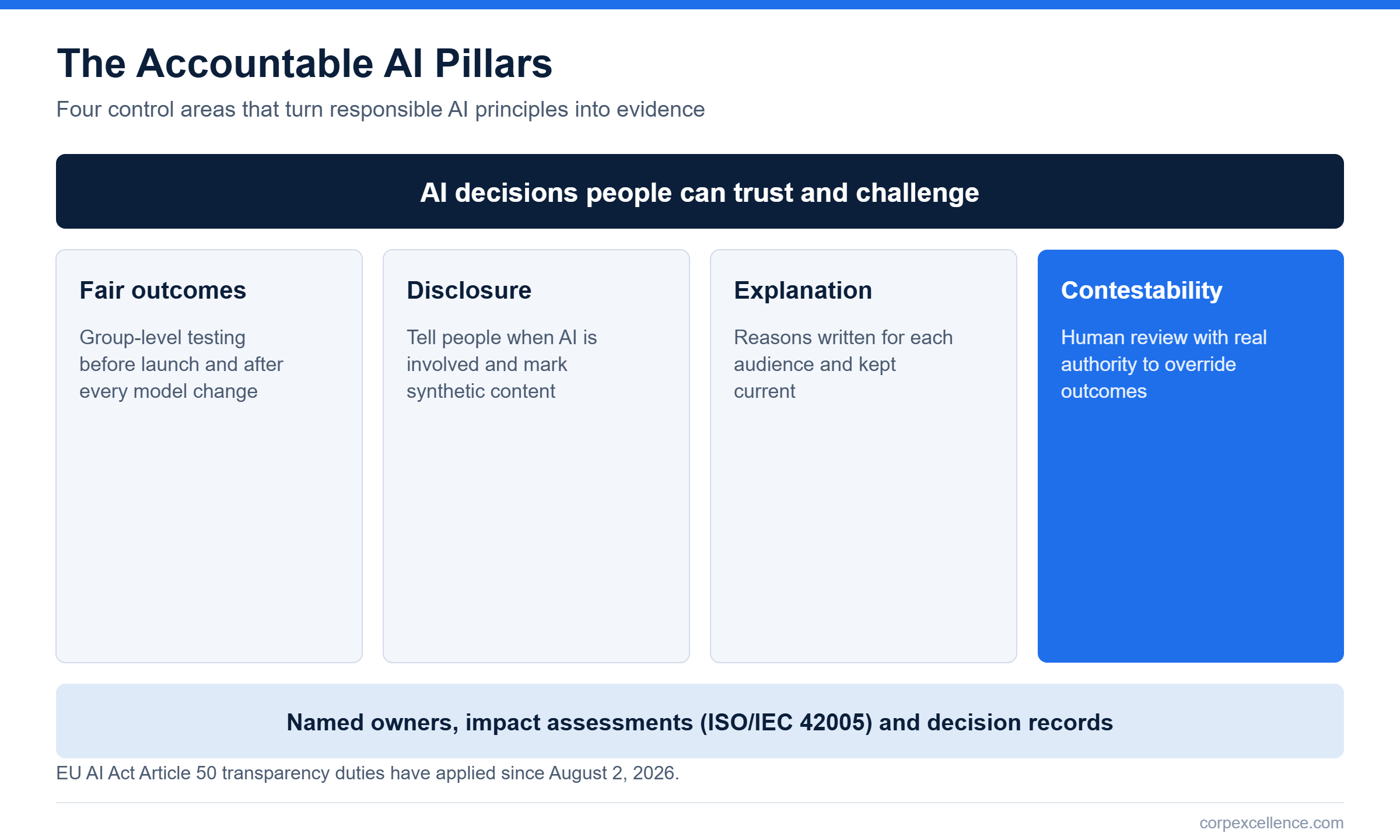
Responsible AI fails when it lives in a values statement and nowhere else. The Accountable AI Pillars, a CorpExcellence framework, turn the topic into four control areas that each produce evidence: fair outcomes, disclosure, explanation and contestability. All four stand on a base of named ownership and impact assessment, and together they hold up one goal: AI decisions that people can trust and challenge.
Fair outcomes
Bias rarely announces itself. It enters through historical data, proxy variables such as postcode, and labels that encode past human judgment. Pick a fairness measure that fits the decision (selection rates for hiring, error rates for fraud screening) and test across relevant groups before launch. Repeat the test after every retraining or model swap. Record the trade-offs you accept, because different fairness metrics often cannot all be satisfied at once.
Disclosure
People should know when they are dealing with AI. Under Article 50 of the EU AI Act, chatbots must tell users they are interacting with AI unless that is obvious, generative systems must mark synthetic content in a machine-readable way, deployers must label deepfakes, and people exposed to emotion recognition must be told. For product teams this means disclosure text and content provenance tooling.
Explanation
Explanations need to match the audience. A regulator needs system documentation and test results. A customer needs the main reasons behind an outcome in plain language. An engineer needs feature attributions or trace logs, which matter more now that agentic systems call tools and take multi-step actions. An internal auditor needs proof that the controls actually ran. Keep each explanation current as the system changes.
Contestability
Accountability becomes real when someone can push back. Give affected people a route to ask for human review, staffed by reviewers who have the context and the authority to override. Track how often overrides happen: a review step that never changes an outcome deserves a closer look.
The base: ownership and impact assessment
Every system needs a named business owner who answers for its outcomes. ISO/IEC 42005, published in May 2025, gives guidance on AI system impact assessment and pairs well with an ISO/IEC 42001 management system. Run the assessment before launch and again when the purpose or the underlying model changes.
Where the industry is now
As of September 2026, the EU AI Act transparency obligations have applied since August 2, 2026. The European Commission published guidelines on these obligations on July 20, 2026, after releasing a voluntary Code of Practice on Transparency of AI-generated Content in June 2026. The AI Omnibus, in force since July 27, 2026, moved most high-risk obligations to December 2, 2027, and gave providers of generative systems already on the market until December 2, 2026 to meet the marking requirement. Disclosure is now a legal duty for many firms selling into the EU; fairness and contestability remain expectations that customers and auditors test.
Common pitfalls
- Principles published with no owner or test attached.
- Human review that rubber-stamps model outputs.
- Fairness tested once at launch and never again.
- Explanations written for lawyers rather than for the people affected.
Questions leaders should ask
- How do we test our high-impact AI systems for unfair outcomes?
- Do people know when AI has influenced a decision about them?
- Do our human reviewers have the authority and information to overrule the AI?
- How can someone appeal an AI-assisted decision?
More in AI Governance, Risk & Compliance
Related research reports
In-depth reports with ready-to-use templates.
- AI-Ready Data$59.99 PDF report
Latest Analysis: Responsible AI
Explore articles addressing this research topic as new analysis is published. The newest articles appear here automatically.
Related research reports
Reports connected to this topic.