
Research · AI Security
AI in Security Operations
Security teams face more alerts, data and threats than they can handle manually. AI can help triage, investigate and respond faster, provided it is supervised and its limits are understood.
The SOC Autonomy Ladder
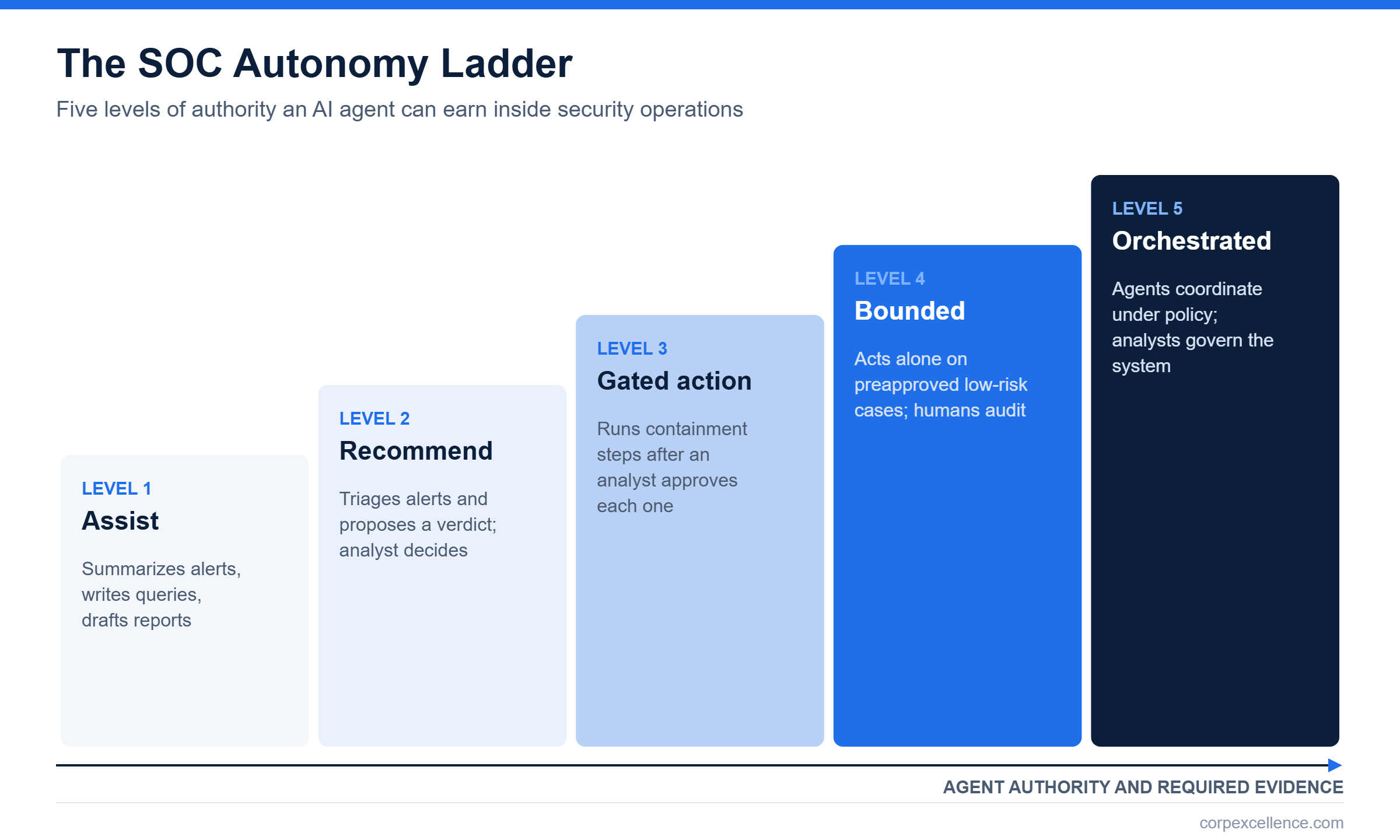
Security teams are moving from AI assistants that answer questions to AI agents that triage alerts and take response actions. The decision for leaders is how much authority to give each AI use case, and on what evidence. The SOC Autonomy Ladder, a CorpExcellence framework, defines five levels of authority. Each use case climbs on its own, and it moves up only after it has produced measured results at the level below. A mature SOC will run different use cases at different levels at the same time.
Assist and Recommend
At the first two levels the analyst still makes every decision. AI summarizes alerts, translates questions into query languages, drafts incident reports and proposes a verdict with its reasoning. Measure how often AI verdicts match analyst decisions and how much time each case saves. That record is the evidence for moving up. Keep a sample of AI-handled cases for weekly human review. Watch for automation bias: analysts who stop reading the underlying evidence because a summary sounds confident.
Gated action and Bounded
At level three the agent prepares and runs response steps, such as isolating a host or disabling an account, but only after an analyst approves each one. Approval prompts should show the evidence as well as the proposed action, so the analyst can judge quickly. Level four lets the agent act alone on a narrow class of cases, for example closing phishing reports that match known-benign patterns, within limits written as policy. Every action must be logged and reversible, and the agent should run under its own identity with only the permissions that class of case needs.
Orchestrated
At the top level several agents hand work to one another under policy, and analysts supervise the system rather than individual cases. Few organizations should run anything beyond low-risk work at this level today. Remember that SOC agents are also targets: an attacker who controls alert text or log content can attempt prompt injection against the agent reading it. The OWASP Top 10 for Agentic Applications applies to your own defensive tools as much as to business agents.
Where the industry is now
As of September 2026, major security platforms ship agents for alert and phishing triage. Microsoft announced Security Copilot agents, including a phishing triage agent, in March 2025, and Google describes an agentic SOC built from multiple cooperating agents in its Security Operations product. NIST’s draft Cyber AI Profile (IR 8596), first released as a preliminary draft in December 2025, treats AI-enabled cyber defense as one of its focus areas. Vendor autonomy claims vary widely, so ask for results measured on your own data before granting more authority.
Common pitfalls
- Granting autonomous response rights before measuring verdict accuracy.
- Sending sensitive logs to an AI service without checking retention and data residency terms.
- Counting AI features enabled instead of measuring triage time and error rates.
Questions leaders should ask
- Which step in our security operations is the biggest bottleneck?
- Which response actions may AI take without an analyst?
- Where does our security data go when AI tools process it?
- How do we measure whether AI is improving detection and response?
More in AI Security
Latest Analysis: AI in Security Operations
Explore articles addressing this research topic as new analysis is published. The newest articles appear here automatically.