Research · Data for AI
Synthetic Data
Synthetic data is generated to mimic the statistical properties of real data. It can speed up AI development, fill gaps and reduce exposure of sensitive records, but it is not automatically private or accurate.
The Synthetic Data Scrutiny Matrix
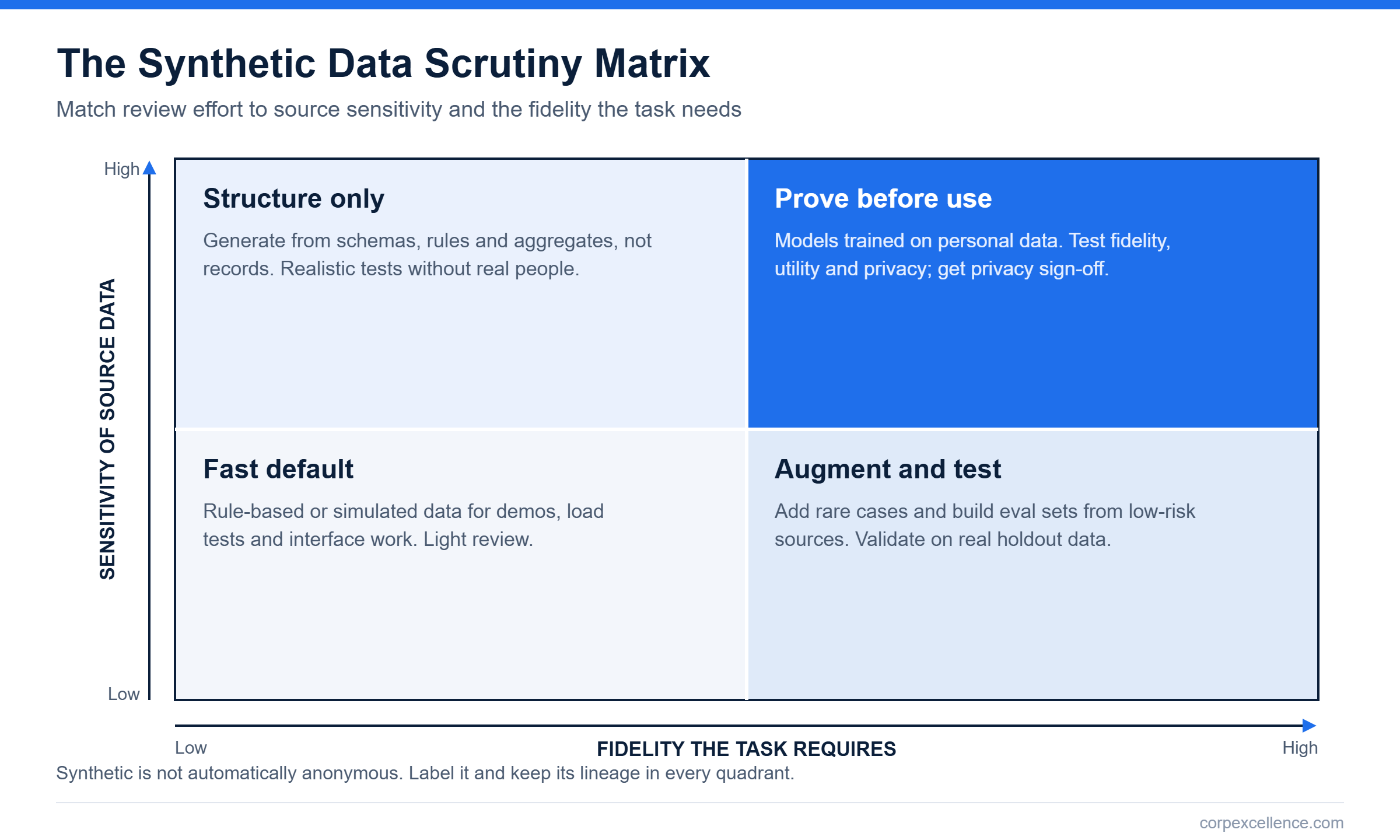
Synthetic data is often discussed as if it carried a single risk profile. It does not. The Synthetic Data Scrutiny Matrix is a CorpExcellence framework that sets the level of review using two questions: how sensitive is the source data the generator learns from, and how closely must the output reproduce real patterns for the task? The answers place each use in a quadrant with its own controls, so teams spend review effort where it counts. Every quadrant still needs one shared rule: synthetic data is labeled as synthetic wherever it travels.
Low sensitivity: move quickly
Fast default covers demos, load tests and interface work where data only needs the right shape. Rule-based generators and simulators are enough, and review can be light. Augment and test covers work where realism matters but the source is low risk, such as sensor readings, product catalogs or public text. Teams use it to add rare cases to training sets and to build evaluation sets for models and agents. The key control is validation against real holdout data, because a model that scores well on synthetic examples can still fail on real ones.
High sensitivity: earn the right to use it
Structure only serves teams that need realistic test environments without copying production records. Generating from schemas, business rules and aggregate statistics keeps individual people out of the generator. Prove before use is the quadrant where generative models learn from personal or confidential records. Fidelity and privacy pull against each other here: the closer the output tracks the source, the greater the chance it reproduces or reveals real individuals. Release should require evidence on four fronts:
- Fidelity: distributions and relationships match the source within agreed tolerances.
- Utility: models trained on the synthetic set perform acceptably on real holdout data.
- Privacy: tests for memorized records, linkage and membership inference pass.
- Approval: the privacy owner signs off, and the dataset is labeled as synthetic with its lineage.
Where the industry is now
European regulators no longer accept synthetic output as anonymous by default. In Guidelines 02/2026 on anonymisation, adopted on July 7, 2026 for public consultation through October 30, 2026, the EDPB warns that synthetic datasets can fail its no-inference criterion and that agentic AI is likely to lower the cost of re-identification, so anonymity must be reassessed over time. A separate concern applies to training on model-generated content. Research published in Nature in 2024 showed that models trained recursively on generated data degrade over generations, losing rare patterns first. The practical response is to label synthetic content, track its share in each training set and keep real data in the mix.
Common pitfalls
- Assuming synthetic means anonymous and skipping privacy review.
- Measuring fidelity but never testing utility on real data.
- Losing track of which datasets are synthetic once they are copied downstream.
- Expecting a generator to produce rare events its source data never contained.
Research report
Know when synthetic data helps and when it misleads
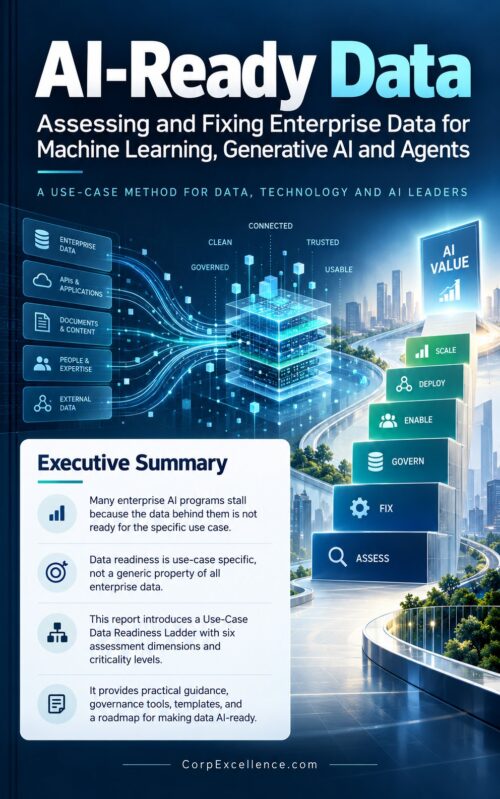
AI-Ready Data places synthetic and augmented data inside a use-case readiness method, alongside quality, representativeness and documentation checks.
New research report
AI-Ready Data
56-page method for assessing and fixing enterprise data for machine learning, RAG and AI agents. Includes worksheets and templates.
Questions leaders should ask
- Where are we copying production data into AI development today?
- How do we verify synthetic data cannot be linked to real people?
- Which AI projects are blocked by lack of data?
- How much of our training data is AI-generated?
More in Data for AI
Related research reports
In-depth reports with ready-to-use templates.
- AI-Ready Data$59.99 PDF report
Latest Analysis: Synthetic Data
Explore articles addressing this research topic as new analysis is published. The newest articles appear here automatically.
Related research reports
Reports connected to this topic.