Research · AI Infrastructure & Operations
MLOps & LLMOps
MLOps applies software engineering and operations discipline to machine learning. LLMOps extends it to generative AI, adding prompts, retrieval pipelines, guardrails and model providers to what must be versioned, tested and monitored.
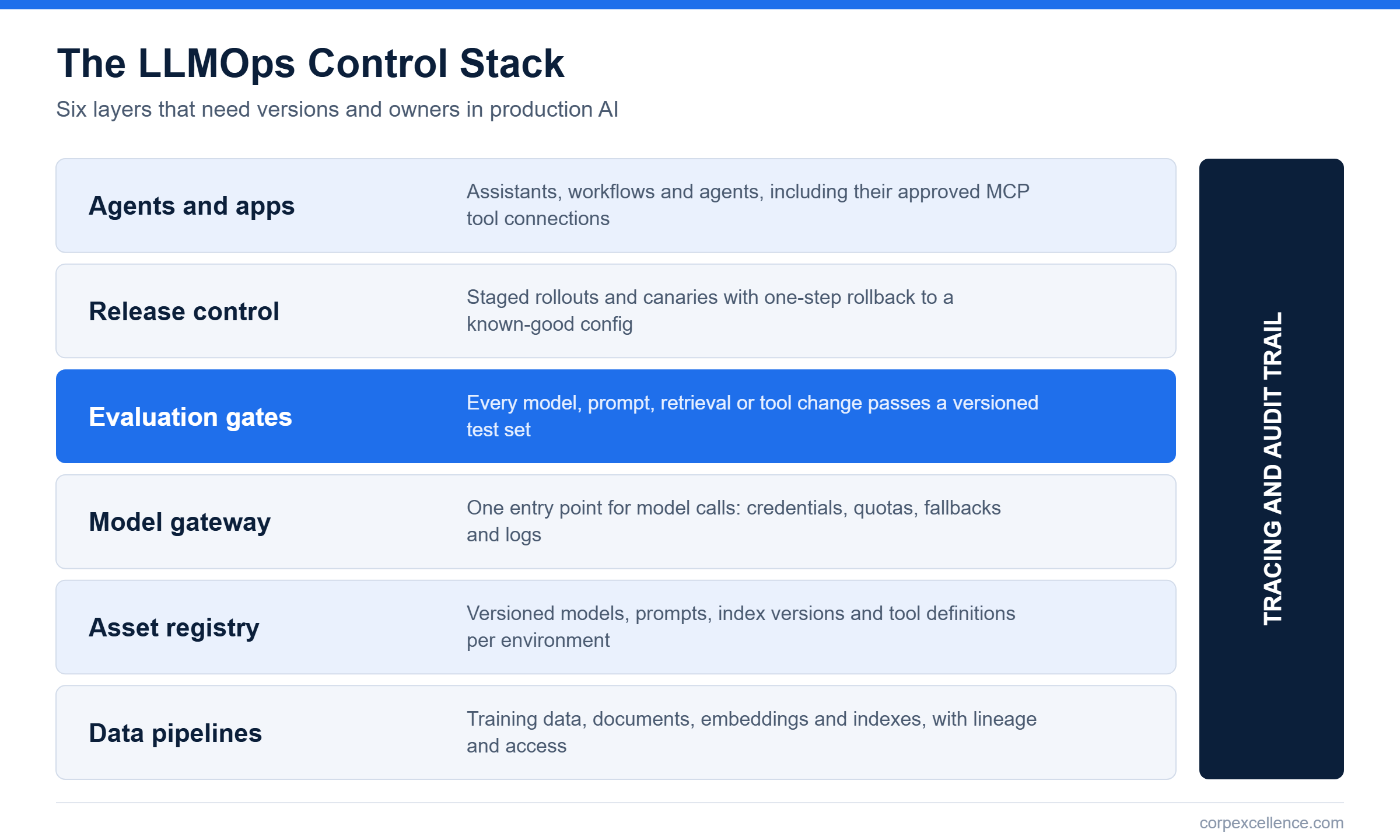
The LLMOps Control Stack
MLOps gave teams versioned models and automated release pipelines. Generative AI and agents add parts that change system behavior without any code change: prompts, retrieval indexes, tool connections and the model provider itself. The CorpExcellence LLMOps Control Stack groups these into six layers. Each layer needs an owner and a change process, and one trace runs through all of them so any output can be explained after the fact.
Agents and applications
The top layer is what users touch: assistants, workflows and agents. Agents call tools, more and more often through the Model Context Protocol (MCP). The list of tools an agent may use is configuration, and it deserves the same review as code. Log every tool call with the identity the agent acted under.
Release control
Ship changes in stages. Run a new prompt or model on a slice of traffic and compare results with the current version. Keep a one-step rollback to the last known-good configuration. Treat a provider’s model upgrade as a release too, even though you did not write it.
Evaluation gates
This is the layer most teams skip and later regret. Every change to a model, prompt, retrieval setting or tool definition runs against a versioned test set before release. Gates block regressions automatically, and people review the cases an automated check cannot judge. Keep the test sets under version control as well, since a changed test set changes what passing means.
Model gateway
Route all model calls through one gateway. It holds credentials, applies quotas and fallbacks, records which model version answered, and lets you move between providers without rewriting applications. Gateways are now a standard product category, offered both by cloud providers and by open-source projects.
Asset registry
Keep models, prompts, retrieval index versions and tool definitions in one registry, with a record of which version is live in each environment. Pin specific provider model versions instead of floating aliases that can change underneath you.
Data pipelines
Training data, documents, embeddings and retrieval indexes need lineage and access controls. A stale or over-shared retrieval index is an LLMOps failure even when the model itself is fine. Re-index on a schedule and remove documents that users should no longer see.
Is your gateway recording what each request costs?
AI Inference Cost Control includes an inference cost data dictionary, a model routing policy template and an architecture review checklist for production AI.
Where the industry is now
Tracing for agents is moving toward open standards. OpenTelemetry’s GenAI semantic conventions now define model spans, agent spans and MCP spans, but as of September 2026 they remain in Development status, so attribute names may still change. MCP itself moved to neutral governance when Anthropic donated it to the Agentic AI Foundation under the Linux Foundation in December 2025. A practical requirement for any LLMOps tool you buy: it must export traces in OpenTelemetry format, so you are not locked into one vendor’s view of your system.
Common pitfalls
- Editing production prompts directly, outside version control.
- Logging outputs without the model version that produced them.
- Letting each team pick its own gateway and tracing tool.
- Granting agents broad tool access during a pilot and never narrowing it.
Research report
Add cost to your LLMOps controls
Get the 52-page playbook covering cost telemetry, routing and cascades, caching, batching, serving efficiency for self-hosted models and cost anomaly alerts.
Featured research report
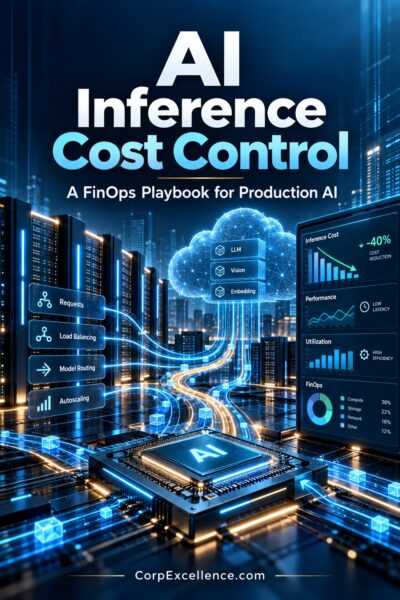
AI Inference Cost Control
52-page FinOps playbook for production AI. Includes a cost-per-transaction worksheet, a model routing policy template and an AI spending governance control catalog.
Questions leaders should ask
- How do we test a prompt change before it reaches users?
- Could we roll back a model or prompt change within minutes?
- Do we know which model version answered a given request?
- How many different AI toolchains do our teams use?
More in AI Infrastructure & Operations
Related research reports
In-depth reports with ready-to-use templates.
- AI Inference Cost Control$49.99 PDF report
- AI-Ready Data$59.99 PDF report
Latest Analysis: MLOps & LLMOps
Explore articles addressing this research topic as new analysis is published. The newest articles appear here automatically.
Related research reports
Reports connected to this topic.