
Research · AI Infrastructure & Operations
AI Cost Management
AI costs scale with usage in ways that traditional software licenses do not. Managing them requires visibility, allocation to owners, unit economics and design choices that avoid paying for more capability than a task needs.
The AI Unit Cost Model
AI spend behaves differently from software licenses because it grows with every request and every agent step. The CorpExcellence AI Unit Cost Model applies the FinOps Foundation’s Inform, Optimize and Operate phases to AI. It aims at one number: a known cost per business outcome, such as cost per resolved support case or per processed claim. Five practices hold that number up, and each maps to a FinOps phase, shown in parentheses.
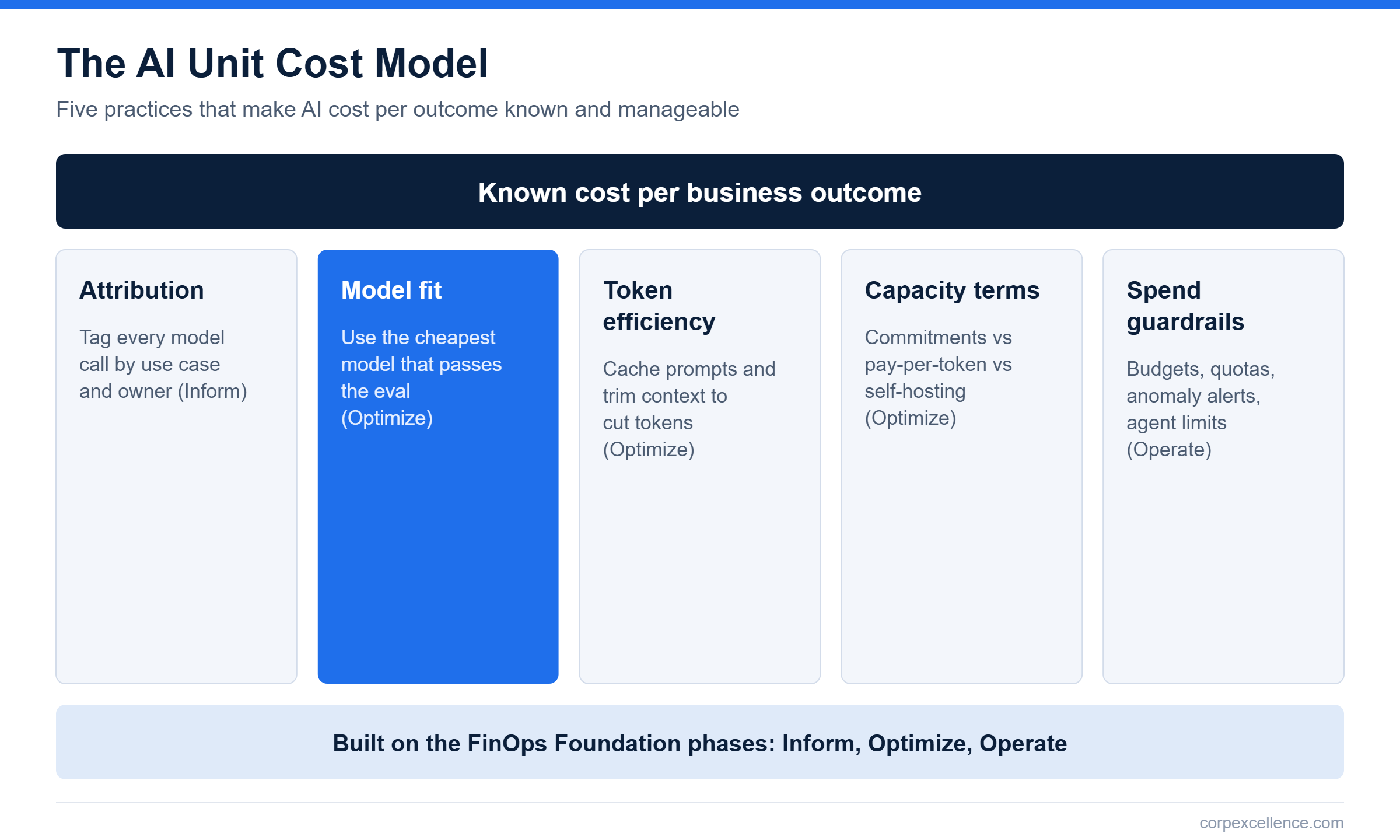
Attribution (Inform)
You cannot manage cost you cannot assign. Tag each model call with its use case and owning team, ideally at the AI gateway, and load provider bills into one format. The FinOps Foundation’s FOCUS specification maps token usage and model SKUs into standard billing columns, so AI charges can sit next to other cloud spend in the same reports. Shared platform costs, such as vector databases and gateways, need an allocation rule too.
Model fit (Optimize)
Send each task to the cheapest model that passes its evaluation. Classification and extraction rarely need a frontier model. Re-test when providers release new model tiers, since both price and capability shift often. Model fit is usually the largest lever, which is why it depends on a working eval suite.
Token efficiency (Optimize)
Trim context, use prompt caching for repeated instructions, cap output length, and move non-urgent jobs to batch processing where providers discount it. Retrieval that returns fewer, better passages cuts tokens and often improves answers. Watch agent workflows closely: each step resends context, so long chains multiply token use.
Capacity terms (Optimize)
Once usage is steady, compare committed-use discounts and provisioned throughput with pay-per-token pricing. Self-hosting open-weight models can win at high volume, but count the engineers needed to run it. Match commitment terms to how long you expect a model to stay in use, since models are replaced quickly.
Spend guardrails (Operate)
Set budgets and quotas per use case and alert on anomalies. Cap agent loops so a runaway workflow cannot consume a month of budget overnight. Review unit cost against business value with product owners on a fixed cadence. Show each team its own unit cost trend, not just the monthly bill.

Need the worksheets behind cost per outcome?
AI Inference Cost Control turns these five practices into a working method, with a cost-per-transaction worksheet, a model routing policy template, a forecast and variance template, and showback and chargeback templates.
Where the industry is now
AI cost is now core FinOps work. In the FinOps Foundation’s State of FinOps 2026 survey, nearly all respondents said they manage AI spend, and AI cost management ranked as the top skill teams need to build. The Foundation’s FinOps for AI guidance, updated in February 2026, emphasizes metrics like cost per inference and choosing the most suitable model for each context. As AI moves into production, spending is tilting from training toward inference, so per-request discipline matters more each quarter.
Common pitfalls
- Defaulting every use case to the most capable model.
- Missing AI charges buried in SaaS seats and marketplace bills.
- Reporting total spend without any outcome measure next to it.
- Letting agent workflows run without per-run cost limits.
Research report
Bring AI inference spend under control
Get the 52-page playbook with eight cost levers, a provisioned-capacity break-even analysis, a 90-day implementation roadmap and an executive AI cost scorecard.
Featured research report
AI Inference Cost Control
52-page FinOps playbook for production AI. Includes a cost-per-transaction worksheet, a model routing policy template and an AI spending governance control catalog.
Questions leaders should ask
- What does one AI-assisted task cost us?
- Which teams and applications drive most of our AI spend?
- Are we using expensive models for simple tasks?
- What share of AI licenses were used last month?
More in AI Infrastructure & Operations
Related research reports
In-depth reports with ready-to-use templates.
- AI Inference Cost Control$49.99 PDF report
- AI Infrastructure Sourcing 2026$49.99 PDF report
Related research reports
Reports connected to this topic.

Latest Analysis: AI Cost Management
Research on inference economics, cost control, architecture decisions and sourcing. The six newest articles are shown here automatically.