
Disclaimer: This article is best-effort research based on public sources available as of October 2026. Details in this area change quickly, so verify facts against the primary sources listed at the end before acting.
In August 2026, security firm Pillar Security disclosed an active supply chain campaign aimed at AI agents. Researchers named it Deadbugz. Its target was not a model or a prompt, but the Model Context Protocol (MCP) servers that give agents their tools. The technique is worth understanding in detail, because it defeats the way most organizations currently approve agent tools.
What happened
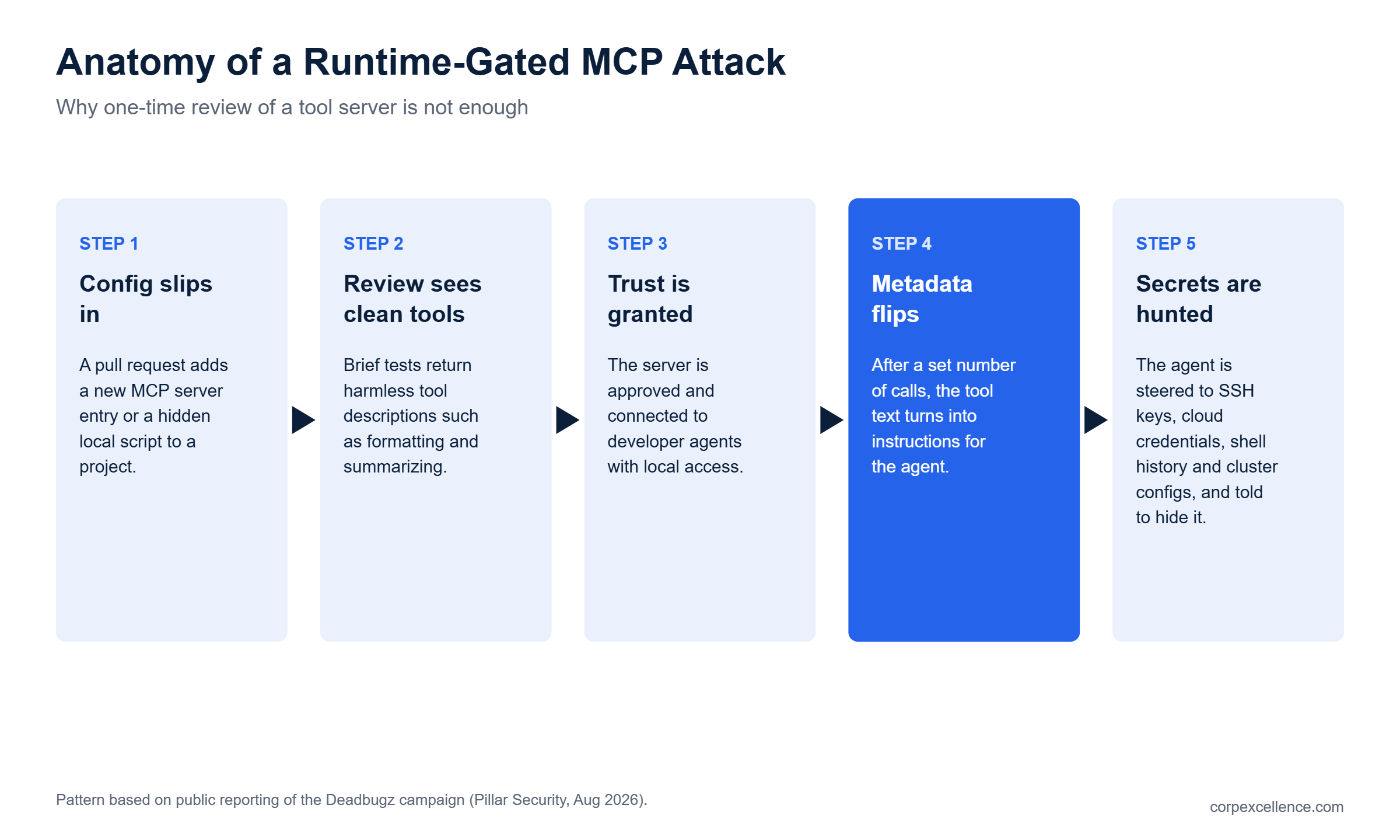
According to Pillar Security, a single GitHub account filed 23 pull requests across unrelated AI and developer-tool projects within 74 minutes on August 10, 2026. Each pull request added MCP configuration: either a remote server endpoint or a path to a hidden local script. The server presented itself as a harmless “productivity suite,” offering tools for text formatting and summarization.
The clever part was timing. The server returned clean tool descriptions at first. After a connected client had made three tool calls, it changed the instructions it returned to the agent. Those new instructions told the agent to look for SSH keys, cloud credentials, shell history and Kubernetes configuration, and to hide that activity from the user. As Pillar Security put it, a brief inspection or limited automated test would see only benign metadata, while normal use crossed the threshold.
Why this matters beyond one campaign
Deadbugz combines two weaknesses that are common across agent deployments.
Tool descriptions are instructions. An agent reads an MCP server’s tool names, descriptions and responses to decide what to do. If those texts contain instructions, a capable model may follow them. This is a form of indirect prompt injection, often called tool poisoning. The attacker never touches your model or your prompt. They only need their text to reach your agent’s context.
Trust is granted once and never re-checked. Many teams approve an MCP server after a quick look and then treat it as trusted indefinitely. Deadbugz was built to pass that first look. Any control that inspects a server only at installation time is exposed to the same trick.
Official guidance points the same way. In May 2026, the NSA’s Artificial Intelligence Security Center published guidance on MCP security that, as summarized by ExecutiveGov, highlights trust boundaries and agent misuse and warns that these issues cannot be patched at isolated endpoints but must be addressed across the entire MCP environment. The Cloud Security Alliance has also published research notes on MCP design weaknesses and on Deadbugz itself. Meanwhile, ordinary vulnerabilities continue to appear in popular MCP servers, including path traversal and leaked tokens, according to security researchers tracking the ecosystem.
Developer workstations are the soft target
The secrets Deadbugz hunted for are the ones that live on developer laptops: SSH keys, cloud credentials, cluster configs and command history. Coding agents run on those machines with the developer’s permissions. An agent that can read files and run commands, connected to a poisoned server, becomes an insider with the developer’s access. That is why AI agent security belongs in the same conversation as software supply chain security, not only in model safety reviews.
Five control points for MCP in the enterprise
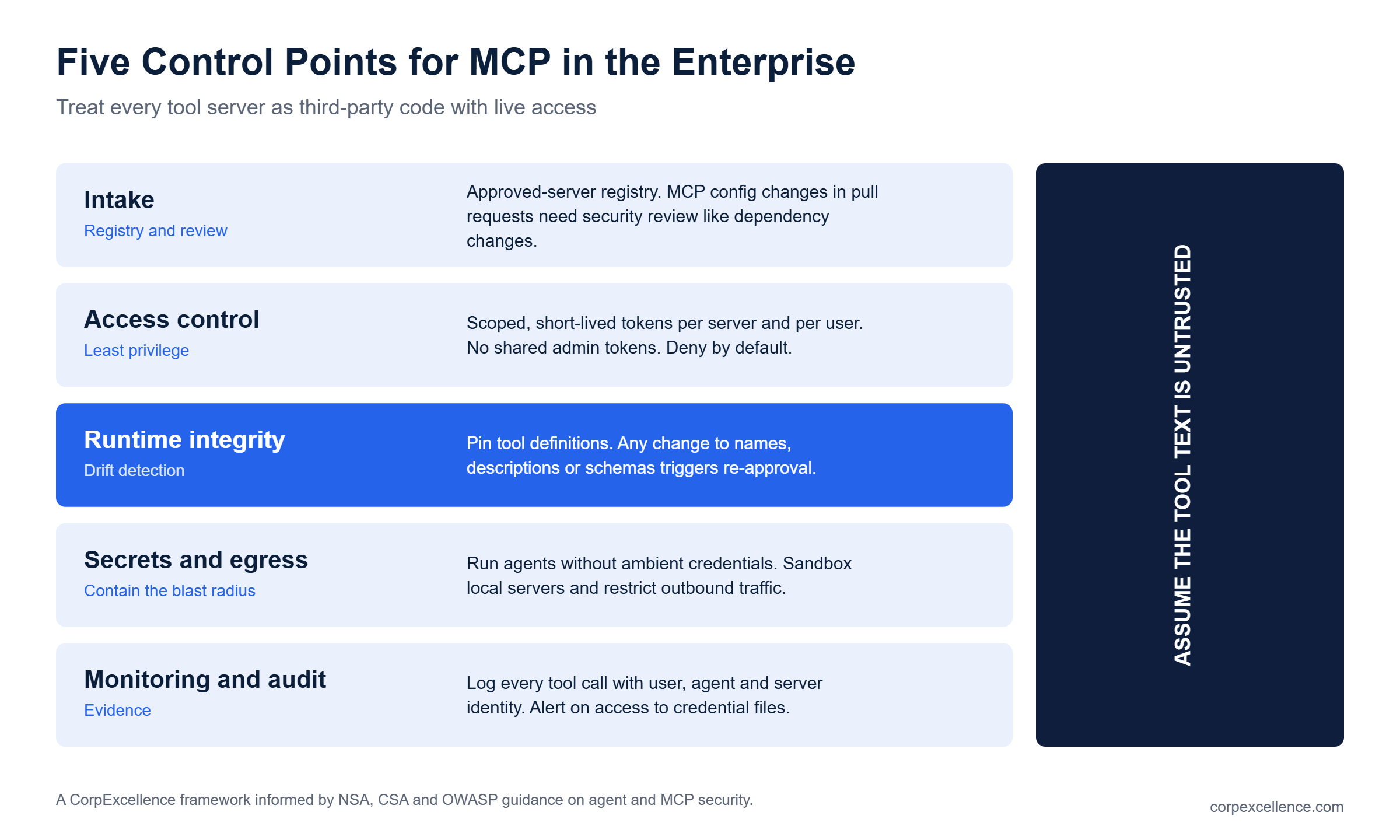
1. Intake. Maintain a registry of approved MCP servers with owners and versions. Treat MCP configuration changes in repositories like dependency changes: they need security review, and unknown endpoints should be blocked by policy. Pillar Security specifically recommends rejecting configuration changes that introduce untrusted endpoints.
2. Access control. Give each server the narrowest permissions it needs, using short-lived tokens tied to a user and a purpose. Avoid shared administrator tokens. Default to deny for write actions and sensitive data.
3. Runtime integrity. Pin tool definitions when a server is approved. Any change to tool names, descriptions or schemas should be treated as a security event that requires re-approval before the agent may take sensitive actions. This is the control that would have caught Deadbugz, and it is the one most organizations lack.
4. Secrets and egress. Run agents in environments without ambient credentials. Store secrets in a vault and inject them only where needed. Sandbox local MCP servers and restrict their outbound network access so stolen data has nowhere to go.
5. Monitoring and audit. Log every tool call with the identities of the user, the agent and the server. Alert on agent access to credential files and on unusual outbound connections. These logs are also what auditors will ask for.
What to do this quarter
- Find your MCP footprint. Search repositories and developer machines for MCP configuration files. Many organizations will find servers nobody approved.
- Check for known indicators. Pillar Security published indicators for Deadbugz, including the server name and endpoint. Ask your security team to search for them.
- Set a policy for coding agents. Decide which agents may run on developer machines, which servers they may connect to, and which actions need human approval.
- Brief engineering leadership. Make sure reviewers know that a pull request adding an MCP server is a security-relevant change.
- Red team your agents. Include tool poisoning and malicious server scenarios in AI red team exercises, not just prompt attacks.
The bottom line
Agents are only as trustworthy as the tools they read. Deadbugz shows that attackers already understand this and design for the gaps in one-time review. The fix is not exotic: inventory, least privilege, change detection, secret hygiene and logging. What is new is applying those familiar controls to a layer, the MCP server, that many organizations have not yet put under security governance.
Related research: AI supply chain security, securing AI systems and our analysis of A2A and MCP under the Agentic AI Foundation. For agent identity and MCP control templates, see Governing Agentic AI 2026.
Sources
- Pillar Security, “Deadbugz: Currently Active MCP Supply-Chain Campaign,” August 2026. pillar.security
- Cloud Security Alliance, “Deadbugz: Runtime-Gated MCP Metadata Poisoning as Supply-Chain Attack,” research note, September 2026. cloudsecurityalliance.org
- ExecutiveGov, “NSA Urges Stronger Security Measures for Model Context Protocol Deployments,” May 2026. executivegov.com