
Disclaimer: This article is best-effort research based on public sources available as of October 2026. Details in this area change quickly, so verify facts against the primary sources listed at the end before acting.
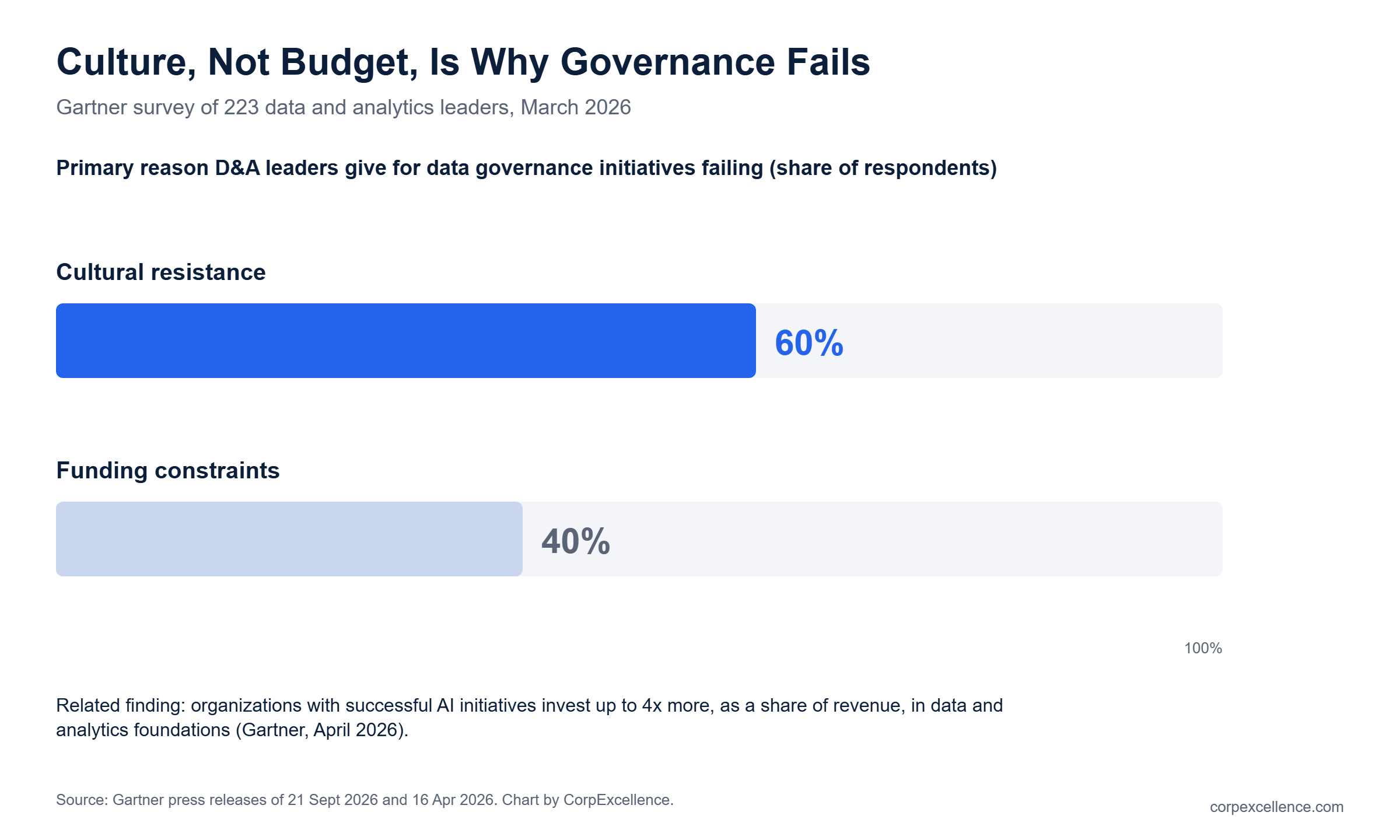
Most AI programs now accept that data is the foundation. Fewer accept what new research says is the real obstacle to fixing it. On September 21, 2026, Gartner predicted that 60% of organizations that ignore data governance culture challenges will fail to govern AI successfully by 2027. In a survey of 223 data and analytics leaders conducted in March 2026, 60% cited cultural resistance as the primary reason governance initiatives fail, compared with 40% who cited funding constraints.
That result should change how leaders plan the data side of their AI investments. If the main barrier is behavior rather than budget, then buying another catalog or quality tool will not solve it on its own.
Why AI raises the stakes
Data governance problems used to show up slowly, as conflicting reports or a delayed audit. AI changes the speed and the visibility. A retrieval system that grounds answers in outdated policies gives confident wrong answers to customers. An agent that queries a table with an undocumented definition of “active customer” will act on the wrong population. A model trained on data with unclear consent creates legal exposure that is hard to unwind.
Gartner’s Anurag Raj framed it this way: organizations are increasingly focused on creating AI-ready data, but AI-ready data also requires AI-ready stakeholders who understand the value of trusted data. In plain terms, the people who create and change data every day have to care about its quality and meaning, or no amount of tooling will keep it trustworthy.
The investment evidence points the same way. In April 2026, Gartner reported that organizations with successful AI initiatives invest up to four times more, as a share of revenue, in data and analytics foundations than those with poor outcomes, and that organizations with the most mature AI-ready data capabilities achieve up to 65% greater business outcomes. Earlier, in February 2025, Gartner predicted that through 2026 organizations would abandon 60% of AI projects unsupported by AI-ready data.
What cultural resistance looks like in practice
Resistance rarely looks like open refusal. It shows up as:
- Governance seen as a tax. Business teams experience data standards as paperwork that slows them down, so they create local workarounds such as private spreadsheets and shadow extracts.
- Ownership without authority. Data owners are named in a policy but have no time, incentive or power to fix problems in their domain.
- Policy far from the work. Rules live in documents nobody reads at the moment they create or change data.
- Success measured in artifacts. Programs report how many policies and glossary terms they produced, not whether decisions or AI outputs improved.
Each of these is a people and incentives problem. Each one also degrades the data AI systems depend on.
Moving governance into the flow of work
Gartner’s recommendations are to align governance to business outcomes, rebrand it as a business enabler and a team sport, and embed it in daily workflows. The four stages below translate that into a maturity path that AI leaders can use to assess where they are.
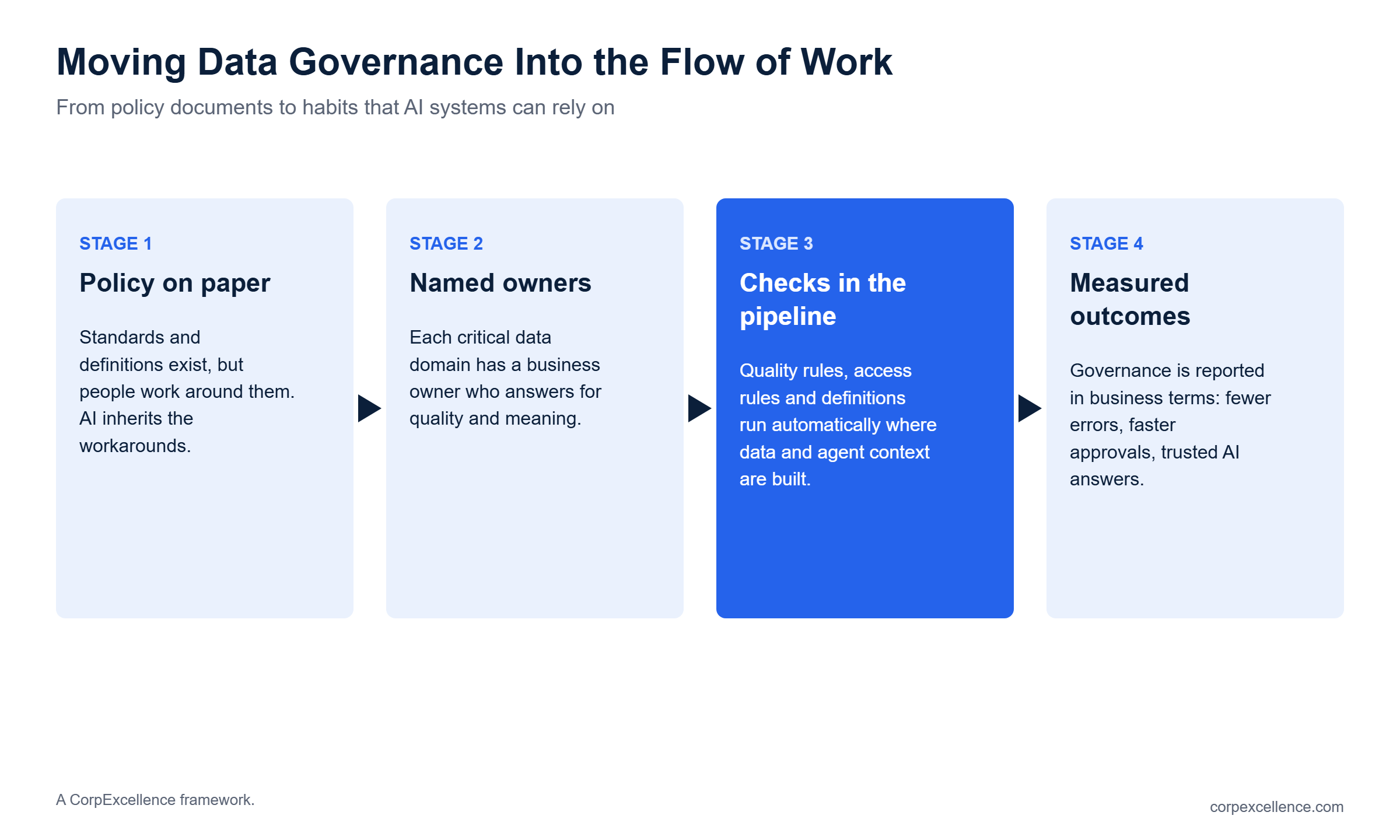
Stage 1: Policy on paper. Standards, definitions and classifications exist, but compliance depends on individuals remembering them. AI systems inherit every workaround.
Stage 2: Named owners. Each critical data domain has a business owner who answers for quality and meaning, with time and authority to act. For AI, start with the domains that feed your highest-value use cases rather than trying to cover everything.
Stage 3: Checks in the pipeline. Quality rules, access policies and business definitions run automatically where data is produced and where AI context is assembled, such as retrieval indexes and the semantic layers agents query. Governance happens by default, not by memory.
Stage 4: Measured outcomes. Governance is reported in terms executives care about: fewer customer-facing errors, faster approvals, higher acceptance of AI answers, and audit findings closed. This is what sustains funding and attention.

Put names on your data, one use case at a time
Our AI-Ready Data report includes a responsibility matrix for data owners, data stewards and AI product owners, plus a readiness worksheet that makes ownership a condition for moving a use case forward.
Five moves for AI and data leaders
- Tie governance to named AI use cases. Governance framed as support for a specific, visible AI outcome earns cooperation that abstract policy never does.
- Give owners time and incentives. Put data ownership in role descriptions and objectives. An owner with no capacity is a name on a slide.
- Govern the context, not just the tables. Agents and retrieval systems consume documents, definitions and metadata. Apply ownership and quality checks to that context layer too. See data governance and lineage for AI.
- Make the right path the easy path. Certified datasets, reusable access patterns and clear definitions in the tools people already use reduce the temptation to work around governance.
- Report value, not volume. Replace counts of policies with measures linked to AI outcomes and business results.
The bottom line
The AI conversation has made data governance fashionable again, and budgets are following. The Gartner findings are a warning that money aimed only at technology will underperform. The organizations that get AI-ready data will be the ones that make trusted data part of how people work, with owners who have real authority and checks built into the pipelines that feed AI.
Related research: Data for AI, data quality and AI readiness and privacy and data sovereignty. For how data readiness affects which AI projects deserve funding, see our 2027 AI budget triage guide.
Research report
AI-Ready Data: assess and fix enterprise data for AI
A 56-page method with the Use-Case Data Readiness Ladder, six readiness dimensions, five scenario playbooks and ready-to-use worksheets and templates.
Sources
- Gartner, “Gartner Predicts 60% of Organizations That Ignore Data Governance Culture Challenges Will Fail to Govern AI Successfully by 2027,” press release, 21 September 2026. gartner.com
- Gartner, “Gartner Says Organizations with Successful AI Initiatives Invest Up to Four Times More in Data and Analytics Foundations,” press release, 16 April 2026. gartner.com
- Gartner, “Lack of AI-Ready Data Puts AI Projects at Risk,” press release, 26 February 2025. gartner.com