
Disclaimer: This article is best-effort research based on public sources available as of October 2026. Details in this area change quickly, so verify facts against the primary sources listed at the end before acting. Prices and supply conditions in this market move monthly; treat figures here as indicative.
For most of the last decade, memory was a commodity line in an infrastructure budget. In 2026 it became one of the most volatile. EE Times reported in June 2026 that memory prices rose by between 50% and 200% in the first half of the year, depending on the product, and that the shortage is expected to last at least through 2027. Dell’Oro Group reported that worldwide data center capital spending grew 92% year over year in the second quarter of 2026, citing rising memory and storage prices as a significant driver of higher server selling prices.
If your organization is planning AI infrastructure, a hardware refresh or a private AI platform for 2027, this is now a first-order planning issue, not a footnote.
How AI created a memory shortage
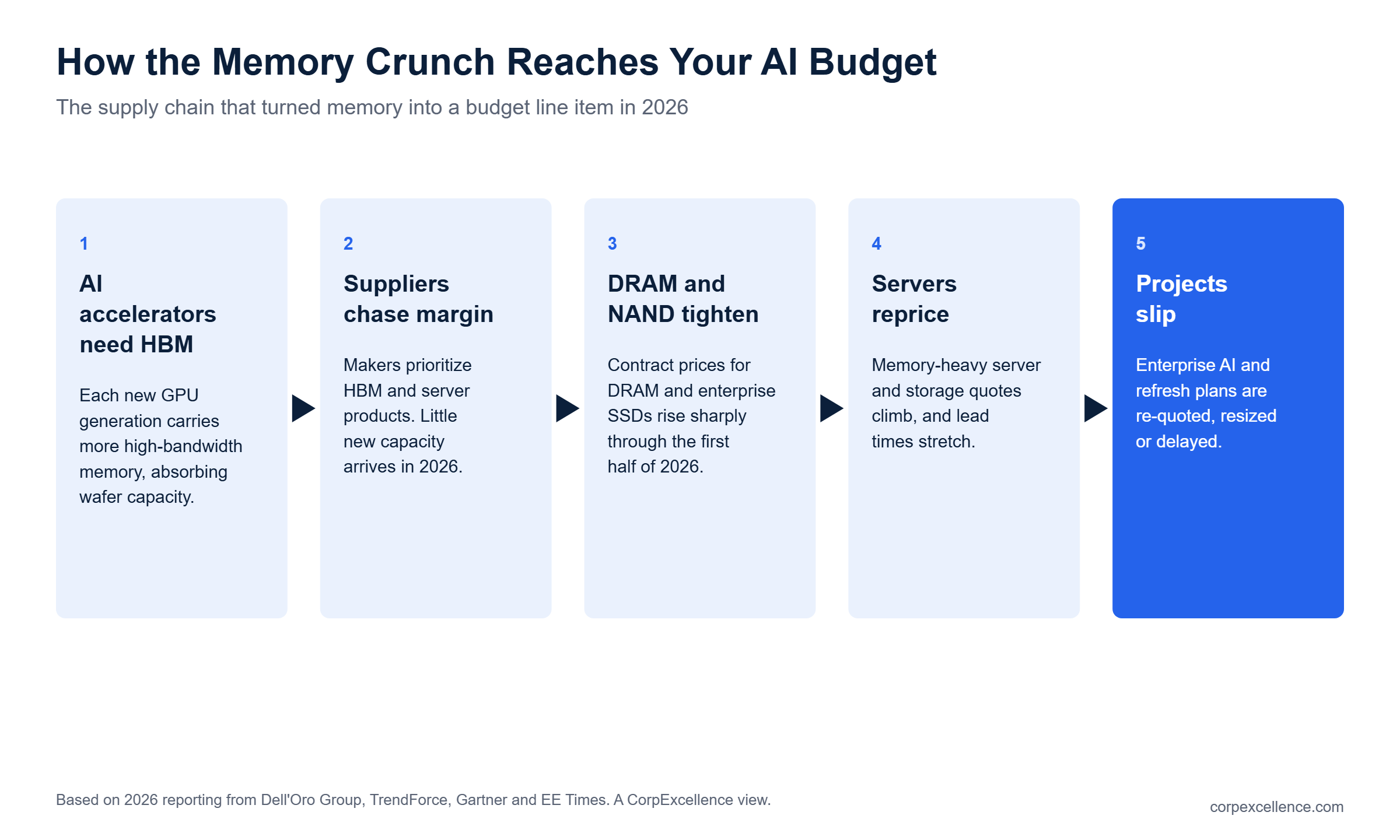
AI accelerators consume high-bandwidth memory. Each generation of AI accelerator carries more high-bandwidth memory (HBM), stacked DRAM that sits next to the processor. HBM uses considerably more wafer capacity per bit than conventional DRAM, so every accelerator shipped absorbs supply that would otherwise go to servers, PCs and phones.
Suppliers follow the margin. Memory makers have prioritized HBM and high-end server products. According to TrendForce analysis cited by EE Times, manufacturers are unlikely to add significant capacity in 2026. New fabs take years to build and qualify.
The squeeze spreads. Conventional DRAM and NAND flash supply tightened as a result. EE Times reported that combined first-quarter 2026 revenue for NAND flash suppliers jumped 83.7% from the prior quarter, to $38.9 billion, a sign of how sharply prices moved.
Servers and storage reprice. Memory and SSDs make up a large share of the cost of AI and data-heavy servers. As their prices rose, so did server quotes. Dell’Oro also noted that supply constraints could limit the pace of deployment through the rest of 2026.
Who feels it most
Hyperscalers and large AI labs buy at a scale that gives them priority allocations and long-term contracts. Enterprises buying through OEMs and resellers have less leverage, shorter quote validity and more exposure to price changes between budget approval and purchase order. Three groups are especially exposed:
- Organizations building private AI platforms for data sovereignty or cost reasons, where GPU servers with large memory footprints dominate the bill.
- Teams planning storage expansions for AI data pipelines, retrieval indexes and model artifacts, where enterprise SSD prices have risen sharply.
- Anyone with a general server or PC refresh scheduled in the next 18 months, since the shortage affects mainstream DRAM, not only AI hardware.
It also affects cloud costs indirectly. Providers pass hardware costs through over time, and capacity constraints can limit the availability of the instance types AI workloads need.
A procurement playbook
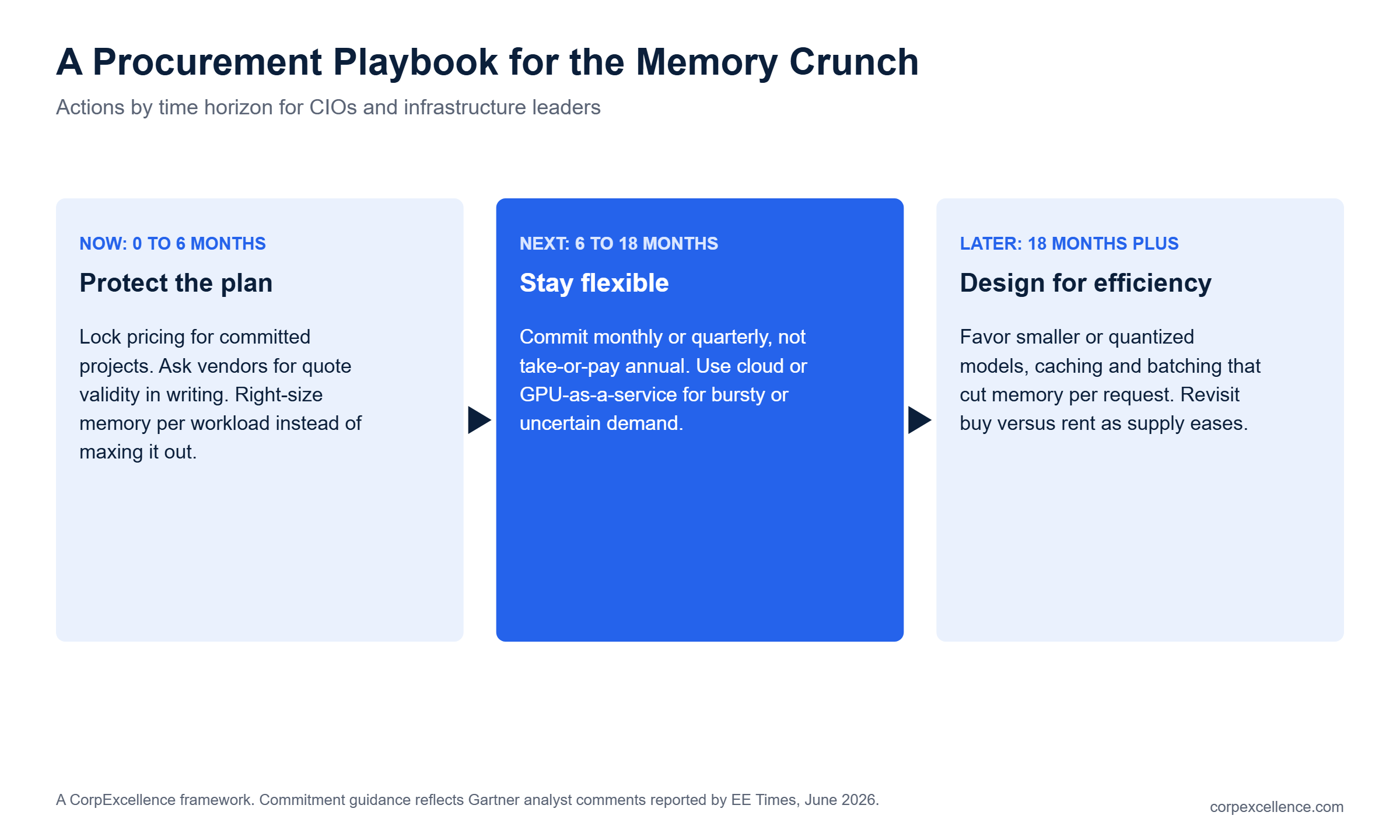
Now (0 to 6 months): protect the plan. For projects already approved, lock pricing and allocations where you can and get quote validity periods in writing. Re-examine memory configurations. Many server specifications are padded by habit, and right-sizing memory per workload can offset part of the price rise.
Next (6 to 18 months): stay flexible. Gartner analyst James Smith, quoted by EE Times, warned that the real risk is turning a forecast into a fixed take-or-pay commitment before the market settles. He recommended forecasting demand 12 to 24 months out but committing monthly or quarterly rather than annually. For bursty or uncertain AI demand, renting capacity from cloud or GPU-as-a-service providers keeps options open.
Later (18 months and beyond): design for efficiency. The most durable hedge is to need less memory per unit of work. Smaller or quantized models, response caching, batching and better retrieval design can all reduce memory per request. Revisit the buy versus rent decision as new capacity comes online.
What it means for AI business cases
Higher hardware prices change the math behind AI projects in ways finance teams will notice. A business case approved in early 2026 on last year’s server quotes may no longer clear its hurdle rate. Re-run the numbers for any project that has not yet placed orders, and model a range rather than a single price. It also strengthens the case for efficiency work that was easy to defer when hardware was cheap: measuring cost per successful task, removing idle capacity and choosing the smallest model that meets the quality bar. Finally, it shifts the balance between owning and renting. Organizations that had planned to bring AI workloads in-house to save money should test whether that saving survives current prices. Our research on build versus buy and AI business cases covers how to structure these decisions.
Questions to ask before you sign
- How long is this quote valid, and what happens to price and delivery if the order slips a quarter?
- Is the memory configuration sized to our measured workload, or to a vendor default?
- What allocation commitment does the vendor make, and what are the penalties if they miss it?
- Could a smaller model or a different serving design meet the same service level with less hardware?
- Would cloud or GPU-as-a-service cover the first 12 months while prices settle?
The bottom line
The memory shortage is a direct result of AI demand, and it is not expected to clear quickly. Leaders who treat memory as a volatile input, with shorter commitments, right-sized configurations and efficiency built into model and serving choices, will protect their budgets. Those who sign large fixed commitments at peak prices, or who assume last year’s server quotes still apply, risk overruns on exactly the projects they most want to succeed.
For a structured comparison of hyperscalers, neoclouds, sovereign cloud and private AI compute, see our report AI Infrastructure Sourcing 2026. To cut the cost of running models once they are deployed, see AI Inference Cost Control. Related research: AI compute and cloud platforms and AI cost management.
Sources
- Dell’Oro Group, “Data Center Capex Grew 92 Percent in 2Q 2026, Driven by Surging AI Demand and Memory Costs,” 2026. delloro.com
- EE Times, “AI-Driven Memory Shortage Upends IT Budgets,” 10 June 2026. eetimes.com