Description
Design the enterprise for AI systems that act, not only AI that answers
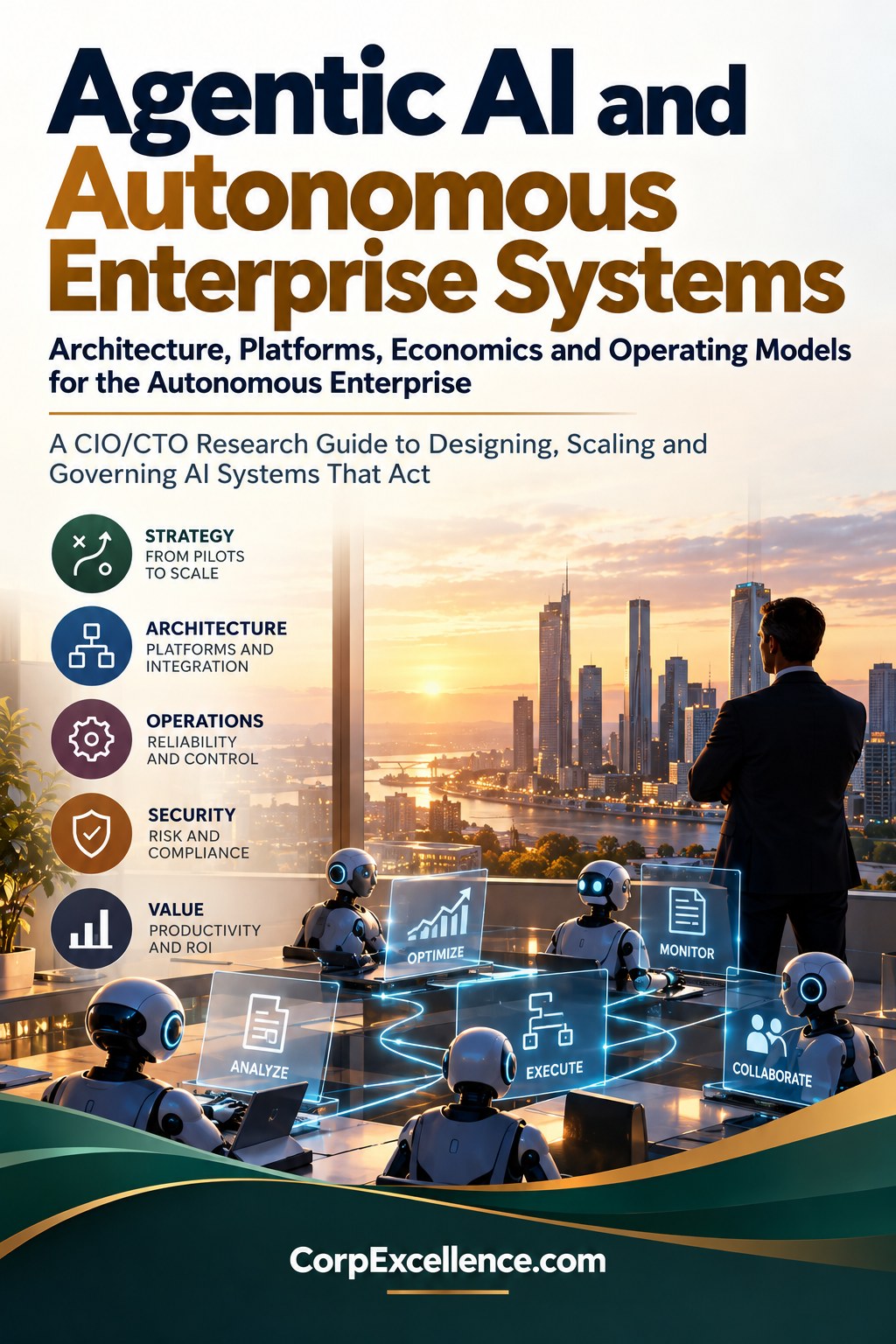
Agentic AI is moving out of individual applications and into the enterprise architecture. Agents now plan multi-step work, call tools and APIs, coordinate other agents and run business processes across systems. Once software can choose and execute consequential actions on its own, the hard problems stop being about model quality. They become architecture problems: identity, authority, durable state, evidence, economics and recovery.
Agentic AI and Autonomous Enterprise Systems is a CIO/CTO research guide to designing, scaling and governing AI systems that act. Its central conclusion is that the autonomous enterprise will be built as a controlled execution system, not a collection of clever bots. Models will keep changing. What lasts is the enterprise control plane around them: identity, policy, tool mediation, durable execution, observability, evaluation, cost controls and the ability to narrow or stop an agent when the evidence deteriorates.
What the report covers
Original frameworks
- The Eight-Layer Autonomy Stack: the architectural layers that must be designed as one system, from user intent through models, context, tools, identity, runtime and economics.
- The Six-Limit Autonomy Profile: six variables that bound every autonomous workload (goal scope, action authority, system reach, time horizon, budget or value exposure, and human review), plus the concept of autonomy debt, the gap between delegated authority and the controls that support it.
- Enterprise Autonomy Stages: a five-level maturity model (M0 Assisted to M4 Federated Autonomous Enterprise) that scores business design, architecture, platform, operational evidence, control and economics together, so progress is limited by the weakest one.
- Autonomous Workload Qualification method: a scored, gated way to decide which work deserves an agent, which needs a simpler assistant, and which should stay deterministic automation.
Architecture and engineering
- Orchestration patterns: when to use a deterministic workflow, a single agent or a multi-agent design.
- Model strategy and routing: model portfolios, routing by task, risk, latency and cost, and qualified fallbacks.
- Context, data and memory architecture, and the four kinds of information an autonomous system handles.
- Tools, APIs, MCP and A2A: how the Model Context Protocol and Agent2Agent fit into the enterprise integration layer and where the policy boundary sits.
- Agent identity, authorization and policy enforced outside the model on every tool call.
- Runtime platforms for long-running work: durable state, checkpoints, retries, idempotency and recovery.
- Reliability engineering and AgentOps: agent service levels, trajectory-level evaluation, telemetry minimums and production control loops.
- Security engineering for the agentic attack surface, with controls mapped to each layer and automatic autonomy-reduction triggers.
- The Enterprise Agent Control Plane, resilience and disaster recovery, transaction safety, and five reference architecture patterns by workload shape.
Strategy, economics and operating model
- Enterprise applications and agentic arbitrage: why value may shift from application screens toward APIs, data semantics, identity and orchestration, and what that means for your software portfolio.
- Economics, unit cost and FinOps for autonomous work: a full cost model and a CFO-ready value scorecard built on cost per successful business outcome.
- Build, buy or compose: platform ownership decisions, sourcing, contracting, concentration risk and exit engineering.
- Operating model, workforce and roles: who owns the agent platform, use-case outcomes and residual risk, and which roles grow in importance.
- The agentic SDLC and how software engineering changes when agents write and run code.
- Portfolio governance, executive metrics and board reporting.
- Auditability, assurance and internal control; global deployment, privacy, residency and sovereignty; and physical infrastructure, energy and capacity.
- Standards and regulation outlook, scenario playbooks for CIOs and CTOs, and an architecture outlook to 2030.
- A 90-day plan and 12-month enterprise roadmap with executive decision gates.
Ready-to-use tools included
The appendices turn the report into a working kit for use-case selection, architecture review, platform due diligence, production readiness and executive reporting.
- Appendix A: Autonomous Workload Qualification Worksheet with scoring and hard gates
- Appendix B: Architecture Decision Matrix across ten design decisions
- Appendix C: 35-question Agent Platform Due-Diligence Questionnaire
- Appendix D: Production Readiness Checklist
- Appendix E: Autonomous System Architecture Review record
- Appendix F: AgentOps KPI Scorecard
- Appendix G: Weighted Build-vs-Buy Scorecard
- Appendix H: Glossary of agentic enterprise terms
- Appendix I: One-Page CIO/CTO Checklist
The report contains 38 chapters, 51 tables and 6 figures, including the ten CIO/CTO decisions that determine whether agentic AI scales, twelve decisions for the 2026 to 2027 planning cycle, a model routing policy, a full cost model for an autonomous workflow, failure modes and recovery patterns, and a 90-day execution plan.
Who this report is for
- CIOs and CTOs deciding where agentic AI belongs in the enterprise architecture and how far autonomy should extend
- Chief architects and enterprise architects designing a shared agent platform and control plane
- AI platform and engineering leaders taking agents from pilot to production
- Enterprise application, sourcing and infrastructure leaders evaluating agent platforms and vendors
- Technology finance partners who need to measure cost and value per business outcome
Report details
- Format: PDF, 55 pages, US Letter
- Edition: Commercial Edition, research current through October 2026
- Sources: 52 numbered references to standards bodies, government agencies, analyst and academic research, and public provider documentation, current as of October 2026
- Delivery: instant download after purchase
- License: the purchaser may use the worksheets, checklists and templates internally. Redistribution, resale or republishing requires written permission from CorpExcellence.com.
This report is independent, best-effort research. It is not legal, regulatory, investment or other professional advice. Agent platforms, protocols, products, prices, regulations and standards change quickly, so confirm current details with the relevant provider, standards body or qualified adviser before acting.


Reviews
There are no reviews yet.