
Does zero data retention mean an enterprise has solved its data-privacy problem? No. It answers one important question about whether particular service interactions are stored by a provider. It does not, by itself, settle where logs live, who can read them, how connected applications handle data, whether a safety exception applies, or how records are deleted. A serious procurement review separates these questions rather than relying on a single reassuring phrase.
On September 1, 2026, Anthropic announced Enterprise Frontier Safeguards, a design intended to combine customer-controlled data storage with monitoring for serious misuse. The company said rollout would occur in phases beginning later in the fall. It described activity data being stored in the customer’s cloud environment under customer-managed keys, with automated monitoring and customer-side human review of flags. These are announced design and rollout statements, not proof that every customer, product, or region has the same capabilities today [1].
Retention is only one of six data-boundary questions
Consider a customer-support application that sends messages to a model, retrieves account records, invokes a ticketing connector, and stores an activity log. Even if the model provider does not retain the message body, the retrieval system, ticketing platform, application database, analytics tools, and security log service may each create or preserve records. The phrase zero retention describes none of those downstream systems unless the contract expressly says so.
A useful contract and architecture review should ask six separate questions:
- Collection: What inputs, outputs, identifiers, metadata, and derived signals are collected, and for what purpose?
- Storage: Which entity holds each copy, in which environment and geography, and under whose encryption keys?
- Access: Who can retrieve content or metadata, including administrators, support staff, subcontractors, and connected services?
- Use: Can data be used for training, abuse detection, diagnostics, evaluation, or service improvement? What opt-outs and exceptions apply?
- Retention and deletion: What is kept, for how long, in which backups and logs, and how can deletion be evidenced?
- Incident and exit: How will the customer learn about an incident, recover data, revoke connectors, and verify deletion at termination?
These questions are connected but not interchangeable. Customer-controlled storage may reduce a provider’s direct custody of logs while leaving the customer responsible for securing the storage account. Conversely, a provider-managed service may offer strong security controls but still be unsuitable for a workload with strict contractual residency limits.
What the new safeguard design changes—and what it does not
Anthropic’s announcement describes a separation between the location of monitoring data and the monitoring process itself. The customer can retain the relevant activity data in its own cloud environment; automated safeguards analyze patterns; and customer personnel review flags. That is a meaningful architectural distinction for organizations that cannot permit routine third-party human access to sensitive records.
But several questions remain deployment-specific: Which product and model qualify? Is the feature available for the customer’s tenant? Where does processing occur? What metadata or classifier signals remain outside the customer’s account? Which support, incident-response, or legal exceptions apply? How do the cloud provider and model provider divide operational responsibilities?
Anthropic’s current privacy-center guidance states that zero-data-retention arrangements are subject to approval and are limited to eligible services and configurations; it also describes limited safety-related retention for certain covered models [2]. This is why buyers should request the exact contract schedule and product configuration, not assume that an announcement or marketing page amends existing terms.
Follow the data across the whole application
A vendor diagram often ends at the model API. An enterprise data-flow diagram cannot. Start with the person submitting a request and trace every transfer: application front end, identity provider, prompt gateway, model endpoint, retrieval index, file store, connector, external system, telemetry, incident logging, and backup. For each arrow, record the data category, legal owner, operator, region, access rights, and retention period.
For example, a contract might promise no retention of model prompts, while a customer-designed observability service logs full prompts for troubleshooting. That does not make the vendor promise false; it means the overall application has a different retention profile. The organization needs a consistent policy covering both. Our discussion of enterprise AI implementation requirements explains why production readiness depends on the surrounding systems as much as on the model itself.
Use a control matrix instead of a yes/no vendor questionnaire
For each sensitive workflow, establish a data classification and acceptable processing boundary. Map the vendor’s answers to evidence: contract language, documented product scope, architecture diagrams, security configuration, audit events, data deletion procedures, and independent assurance where available. Assign each control to the party that can actually operate it.
| Control | Evidence to request | Failure to watch for |
|---|---|---|
| Data custody | Storage diagram, key ownership, regions | Undocumented secondary copies |
| Human access | Role list, support access, approval and logs | Broad standing privileges |
| Retention | Service-by-service schedule, exceptions, backups | Marketing promise narrower than deployed scope |
| Deletion | Deletion procedure, logs and exit obligations | No evidence of downstream deletion |
The NIST Privacy Framework provides a voluntary risk-management structure for identifying and managing privacy risks. NIST SP 800-53 offers a catalog of security and privacy controls that organizations can tailor to their needs [3]. Neither replaces a product-specific legal or technical review.
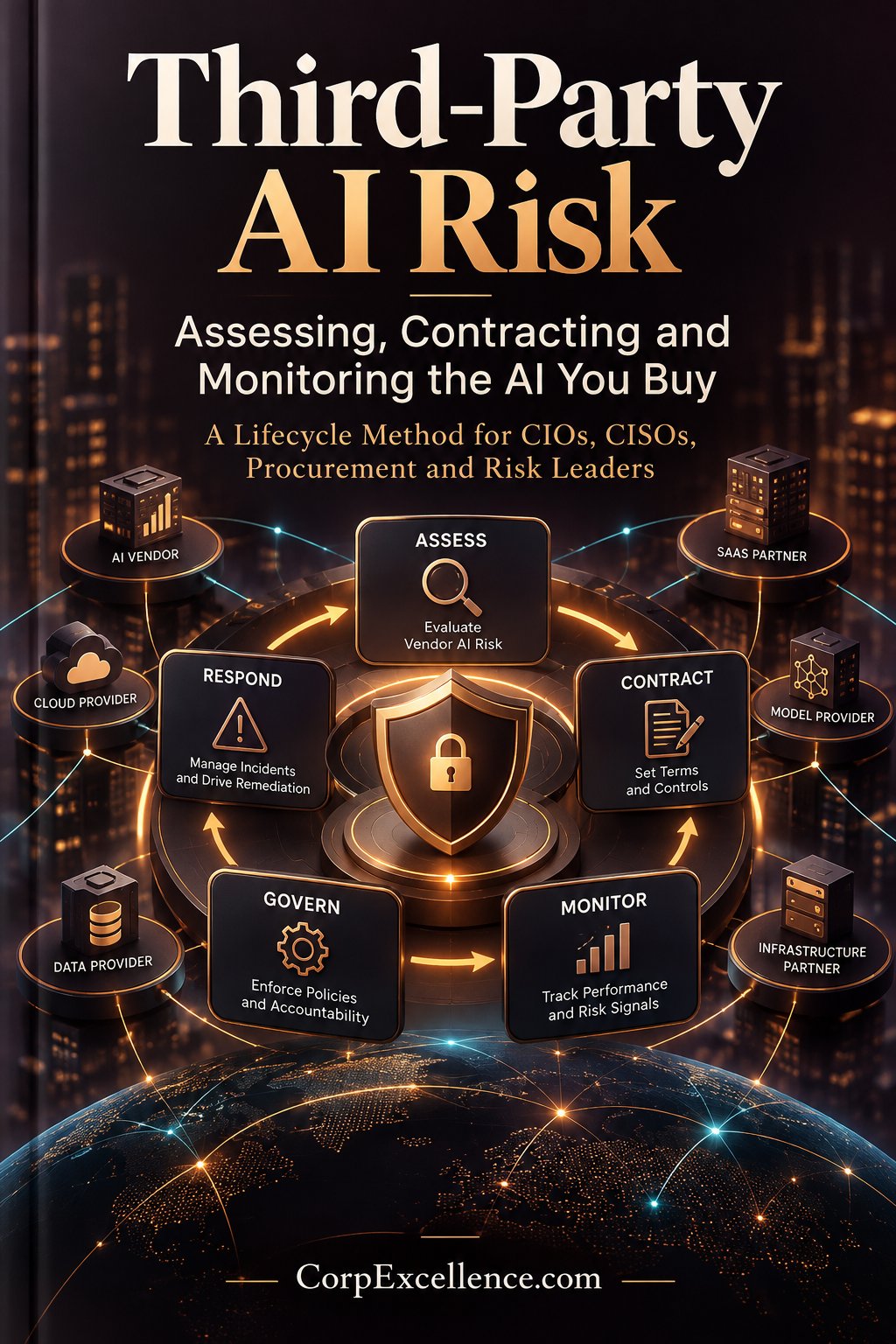
RECOMMENDED PAID RESEARCH REPORT
Third-Party AI Risk
A practical research guide to assessing providers, defining contractual protections, assigning control owners, and monitoring third-party technology risk.
A practical procurement and deployment sequence
Before selecting a provider: Classify intended data and list prohibited uses, required regions, allowed subprocessors, retention limits, and review obligations. During evaluation: Ask for a data-flow diagram, the applicable service-specific terms, the list of exceptions, and a demonstration of access controls and deletion. Before production: Test connector permissions, logs, backup handling, and account revocation with representative but non-sensitive data. After launch: Reconcile configuration changes, new model features, incident notices, and vendor policy revisions against the original approval.
The critical skill is to make every promise testable. If a supplier says customer data stays under customer control, identify the specific storage accounts, keys, administrators, and logs that demonstrate it. If a supplier says a product does not retain prompts, ask how error handling, safety monitoring, and downstream connectors fit that statement.
This article expands the Privacy and Data Sovereignty in AI research hub and complements our work on responsible AI delivery, security, and accountability.
Bottom line
Zero data retention can be a valuable contractual and technical safeguard, but it is not a substitute for a complete data-boundary assessment. The more useful question is: Can we trace every sensitive record, name who controls it, explain why it exists, and prove when it is gone? If not, the procurement review is not finished.
References
- Anthropic, Developing Enterprise Frontier Safeguards with our customers, September 1, 2026.
- Anthropic Privacy Center, scope and exceptions for zero-data-retention arrangements, accessed October 12, 2026.
- NIST Privacy Framework, official overview.
- NIST SP 800-53 Rev. 5, Security and Privacy Controls for Information Systems and Organizations.
Leave A Comment